
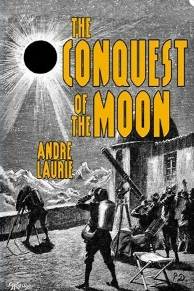
 THE CONQUEST OF THE MOON (1887) – Written by French author Paschal Grousset under the alias Andre Laurie. This work ranges from absurd to fascinating, with – for people looking for science fiction – WAY too much time devoted to the fighting in the Sudan during 1884 and 1885.
In Australia, two German conmen – Ignaz Vogel and Costerus Wagner – team up with an American conman named Peter Gryphis. The trio launch a scheme to bilk scientifically ignorant tycoons by getting them to invest in their company which will supposedly conduct mining operations on the moon.
Hundreds of thousands of pounds are raised from the trio’s victims, who are thoroughly bamboozled until a stockholders’ meeting in Melbourne, Australia. Gryphis, Vogel and Wagner are successfully maintaining their ruse until, from the audience, French astronomer Norbert Mauny speaks up, demanding a detailed explanation of how the conmen plan to reach the moon. Continue reading
 THE AIR BATTLE: A VISION OF THE FUTURE (1859) – Written by an unknown author using the name Herrmann Lang. (Ignore the misspelling on the cover to the left.) Speculation has it that the author was British despite the German pseudonym and despite the narrator’s claim that he is a black man.
 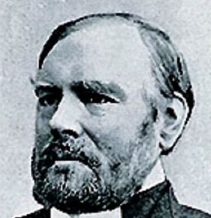 A VOICE FROM ANOTHER WORLD (1874) – Written by W.S. Lach-Szyrma. The 1874 date marks when a selection of stories that Lach-Szyrma had written beginning at some point around 1865 in untraced magazines were finally collected in novel form. The author penned more novels in the series as the years went by.
  Eventually during his years traveling among human beings, “Dr. Posela” rescues a friendly Englishman who is among those trapped in the Siege of Paris during the Franco-Prussian War. The Earthling gets returned to England, and is delighted with Dr. Posela and his philosophical observations about humanity and his theories that life certainly exists on many other planets.
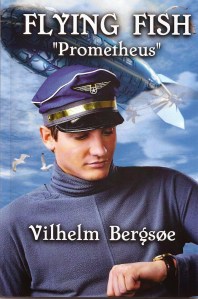 MEMOIRS FROM A JOURNEY WITH THE FLYING FISH “PROMETHEUS” (1870) – Written by Danish author Vilhelm Bergsoe. I shortened the title in the heading for this blog post. Some editions shorten it even more, to just Flying Fish Prometheus.
  William’s American colleagues send the new airship Prometheus to fetch him. The Prometheus is cigar-shaped (like so many UFOs would be described decades later) and sports wings plus propellors. Our man Stone boards the airship in Koege, along with other passengers including his love interest Anna Blue.
  A FANTASTICAL EXCURSION INTO THE PLANETS (1839) – Written by an unknown author. The anonymous narrator of this novel is taken on a visit to assorted planets and other celestial bodies. The figure who transports him is a winged, rainbow-colored sprite whose face and body constantly change slightly, allowing no lasting impression to be made out.
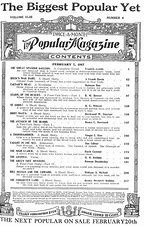 THE FORGOTTEN LAND (1917) – Written by H. H. Knibbs. This writer was much better known for his poems about the American West. The Forgotten Land ventured into science fiction and “future history.”
  Konstantin Eduardovich Tsiolkovsky did real-life work crucial to space-flight and is one of the neglected pioneers of Science Fiction. Balladeer’s Blog takes a look at a few of his works.
  These flying plant-people from the Asteroid Belt obtain nourishment through chlorophyll and solar radiation. They also have advanced technology like the harnessing of dismantled asteroids into rings, resulting in lower gravity for manufacturing work.
  OUT OF THE EARTH (1920) – Set in the year 2017 A.D. this tale features what readers are told is the first manned flight to the moon, some 48 years AFTER it happened in real life.
 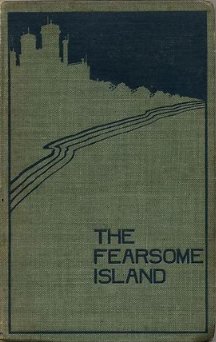 THE FEARSOME ISLAND (1896) – Written by British author Albert Kinross. An unusual work with a multi-layered narrative. The entire novel was penned by Kinross, but it is one of the countless works of fiction presented as if it is a rediscovered manuscript relating the “true” adventures of Silas Fordred from the 1500s. Kinross adds another layer by explaining the sci-fi devices that Fordred could not comprehend and put down to sorcery and the supernatural.
  AFTER LONDON aka WILD ENGLAND (1885) – Written by Richard Jefferies. A post-apocalypse saga in which the shifting of the Earth’s axis has reduced the British Isles to a medieval level with feral animals and pockets of toxic wasteland. There are scattered “kingdoms” and roving bands of marauders but no contact with the world outside the area.
  The Thames and Severn Rivers have backed up, forming a large central lake in England. What was once London is a toxic marsh so deadly to human life that its gases and vapors, when carried by the winds, kill or drive mad humans exposed to them.
 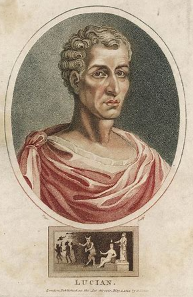 These two works were written by Lucian, the Greek philosopher and satirist who lived in the 2nd century A.D. Lucian was noted not just for his philosophical observations but also for two works that defied definition by his contemporaries but would easily fall into the category of science fiction today. Both works are from roughly 150 A.D. and feature trips to the moon by pseudo-scientific means.
 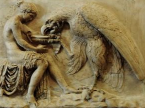 He discovered that the moon (on which he could breathe just like on Earth) was populated by the souls of the deceased (roughly twelve hundred years before Dante’s Paradiso). From the moon Menippus made the astonishing observation that the Earth was round and not flat, in a wry addition to the then-ongoing philosophical debate about the subject.
  Balladeer's Blog