
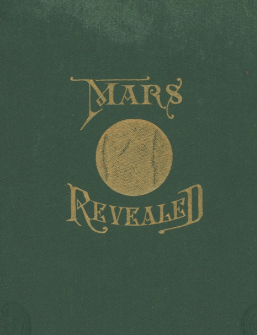
 MARS REVEALED (1880) – Written by Henry A. Gaston, this is another work that combines science fiction with religious and spiritual concepts.
The novel’s narrator, while walking in the hills of northern California during springtime, is approached by a Celestial Spirit. The spirit interrogates him about his lack of knowledge regarding the arcane secrets of the other planets in our solar system.
Our narrator expresses a willingness to be tutored in those secrets and the spirit offers to show him any planet of his choice. He selects Mars and the Celestial Spirit flies off with him toward the Red Planet. The voyager is awed by the sight of Earth far below and by the hills and valleys of the moon as they fly past it.

BALLADEER’S BLOG
Approaching Mars, the Earthman sees that the planet has a pink atmosphere and, rather than be all red like it appears from Earth, the Martian surface is red mixed with silver and green. After circling Mars a few times, the Celestial Spirit and the Narrator land atop the highest mountain peak on the planet.
Mountaintops on Mars are covered in snows that have a pink tinge to them because of the pink atmosphere. Trees larger and taller than any on Earth grow far down from the peaks and those trees give off a perfumed scent. Continue reading
 THE RAINBOW OF ADAMANT (1897) – Written by Charles Kelsey Gaines, this short story is an excellent example of how slowly word of scientific discoveries was spread in the 19th Century compared to our lightning-fast communications of today. The Rainbow of Adamant was written during the period when most of the world was still going by assumptions and theories about helium.
  THE SICKLE OF FIRE (1896) – Written by Charles Kelsey Gaines, an American author who set this particular short story in British Columbia. The main characters are our narrator and a scientist named O.D. McKazy.
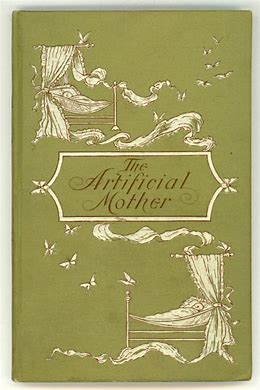 THE ARTIFICIAL MOTHER (1894) – This short story was written by George H. Putnam, who served in the Union Army during the U.S. Civil War and was also a Prisoner of War. He was part of the Putnam publishing empire and in 1901 authored the children’s story The Little Gingerbread Man.
  A.D. 2000 (1890) – Written by Alvarado M. Fuller, this was one of the earliest imitations of Edward Bellamy’s 1888 work Looking Backward. The main character is a Cavalry Lieutenant named Junius Cobb.
  With the cooperation of friends, Lt. Cobb seals himself away in a San Francisco replica of the Statue of Liberty with an alarm set to revive him in the year 1987. Due to a mathematical error, however, our main character is not awakened from suspended animation until the year 2000 A.D.
  THE PLANET JUGGLER (1908) – Written by J. George Frederick. An early space opera set in an undesignated future year. Absurdly enough, Esperanto has become the global language in a reflection of the high hopes held by Esperanto speakers at the time this book was written.
 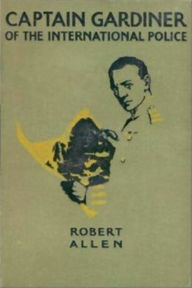 CAPTAIN GARDINER OF THE INTERNATIONAL POLICE (1916) – Robert Allen Dodd wrote this story over one hundred years ago under the name Robert Allen. Narration informs us that the story is set 60 years after the conclusion of the then-raging World War. Since we know it ended in 1918 we can look forward to visiting the “far-off future” of 1978.
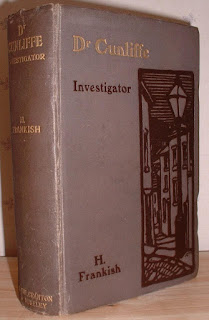 DR. CUNLIFFE, INVESTIGATOR (1913) – Written by Harold Frankish. This book was a collection of short stories centered around Frankish’s fictional “scientific detective” Dr. Theodore Cunliffe.
 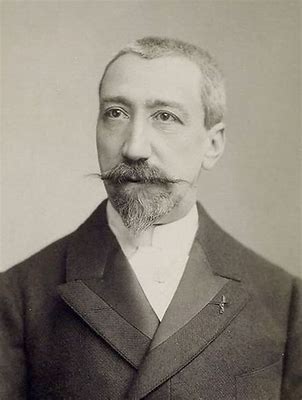 THROUGH THE HORN OR THE IVORY GATE (1905) – Written by Anatole France. In this story a Frenchman, the tale’s narrator, finds himself in the year 2270 A.D. The large buildings that used to fill Paris have been replaced by small cottages inhabited by people whose tastes run to fine art and statuary.
  Balladeer's Blog