The 4th of July holiday is rapidly approaching, so here is another seasonal post from Balladeer’s Blog. In other blog posts I’ve examined the post-Yorktown battles in 1781 and 1782 in detail, but this item will deal with smaller, neglected clashes.
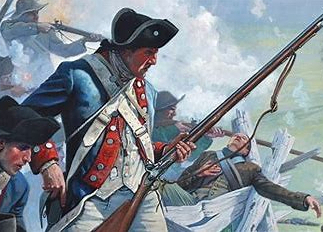 OCTOBER 24th – Near Sandy Hook, NJ American rebel Captain Adam Hyler leads an unknown number of men in a clash with an unknown number of British Loyalists. Hyler takes 6 prisoners during the action.
OCTOBER 28th – Vince’s Fort, SC, manned by 80 American rebels under Captain Joseph Vince, was attacked by Colonel Hezekiah Williams’ British Loyalist forces in the area. The Americans successfully drove off the attackers with minimal casualties.
OCTOBER 30th – At West Canada Creek, NY, the site of a larger battle in September, American Colonel Marinus Willett led 400 New York militiamen and over 60 Oneida Indians allied with the U.S. Willett’s forces clashed with 750 of Major John Ross’ Tory troops and Native Americans who sided with the British. Colonel Willett’s men were victorious, and Tory officer Walter Butler, one of the most blood-soaked Loyalists during the war, was among those killed.
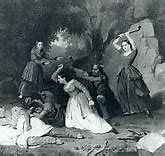 NOVEMBER 1st-6th – At Gowen’s Fort, SC, Roebuck’s Battalion and civilian non-combatants were attacked and besieged by a combined force of British Loyalists and Chickamauga Indian allies of the British. On November 6th, the Americans surrendered after the Loyalist Captain William Bates guaranteed their safety.
However, after the fort’s gate was opened, Bates ordered all those inside – including women and children – to be killed. Details are hard to nail down from this action and no estimates of American and Loyalist numbers are available. Mrs. Abner Thomson, scalped and left for dead, was one of the few survivors. Continue reading →

 Balladeer’s Blog wishes a happy birthday to the USA! What happened in early July of 1776 certainly needs no rehashing so in keeping with my blog’s theme of addressing more out of the way subjects this post will examine various events that took place on other July 4ths throughout American history.
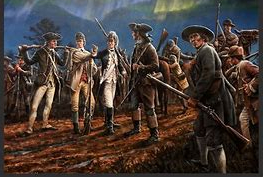 MARCH 1st – British troops led by Major John Maitland landed and took Cockspur Island at the mouth of the Savannah River in Georgia. The Redcoats clashed with American Militiamen and drove them off. Both sides were left with wounded men following the exchange of gunfire, but no fatalities are known.
  Four British warships, along with multiple smaller vessels, launched a joint land and sea effort to seize American rice ships in the area in order to feed the British forces. Over 300 British infantrymen took part in commandeering the rice boats by surprise overnight.
  JANUARY 8th, 1776 – In Charlestown, Massachusetts, British troops and American Tories were attending a performance of General John Burgoyne’s play The Blockade of Boston. The play was a farce ridiculing the supposed inadequacies of the American rebels. An unknown number of American soldiers carried out a raid on the town, panicking the theater audience, capturing 5 British soldiers and destroying 8 Tory buildings.
  THE SIXTH OF JUNE – Many sites are marking the larger event of the D-Day Invasion during World War Two on this date, but in keeping with Balladeer’s Blog’s theme of neglected and obscure items I’ll take a look at a forgotten action from America’s Revolutionary War. With the 4th of July less than a month away, similar seasonal posts will follow in the weeks ahead.
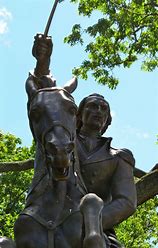
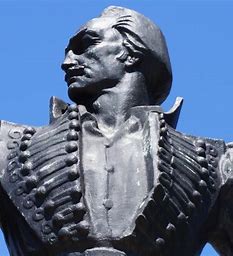
 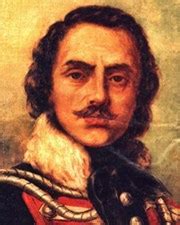 CASIMIR PULASKI (1747-1779) -Obviously from my last name I’m Polish-American and therefore grew up immersed in the role played by Casimir Pulaski and Tadeusz Kosciuszko in America’s War of Independence. I’m often surprised by how comparatively unknown they are to the public at large, so in keeping with Balladeer’s Blog’s theme here’s a look at Pulaski. I’ll cover Kosciuszko separately.
  The war never became as romanticized as the later Greek War of Independence from the Ottoman Turks, but the conflict drew attention to Russian totalitarianism and to the abilities of Polish officers like Casimir Pulaski. In fact, it took an invasion by Russian-allied Austria and Prussia to help Russia put down the rebellion in 1772.
  Franklin was impressed with what he could learn about Pulaski and sent him on to America with a letter of introduction to George Washington. Franklin described the Pole as “an officer famous throughout Europe for his bravery and conduct in defence of the liberties of his country against the three great invading powers of Russia, Austria and Prussia … may be highly useful to our service.”
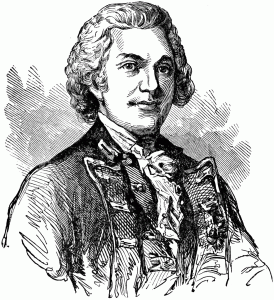 CAPTAIN SILAS TALBOT – Even if he had never gone on to a career in Privateering, Talbot would still have been a fascinating figure from Revolutionary War history. On June 28th, 1775 Silas was commissioned as a Captain in a Rhode Island regiment and served in the military operations which ended with the British surrender of Boston in March of 1776.
 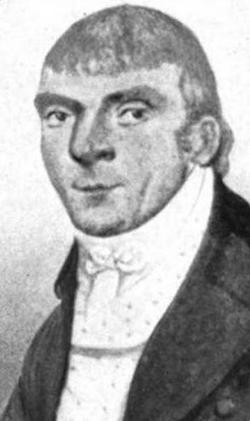 “THE SALAMANDER” – Previously I covered Haraden’s career in the Massachusetts Navy as First Lieutenant and later Captain of the legendary commerce raider Tyrannicide. After two years on board that vessel, by the summer of 1778 Captain Haraden left the Massachusetts Navy to command the privateer ship the General Pickering. Haraden’s fame would fly even higher as he earned the nickname “The Salamander,” a play on words regarding his ability to withstand fire.
  Always a consummate swashbuckler, Haraden would sometimes capture a British prize even while transporting a cargo across the Atlantic. Off Sandy Hook, NJ on October 13th, 1779 the good captain added to his legend by taking on THREE British privateer vessels at once. The Brits outgunned the 16-cannon General Pickering by 14, 10 and 8 cannons but the Salamander coolly emerged triumphant and towed in all three defeated craft.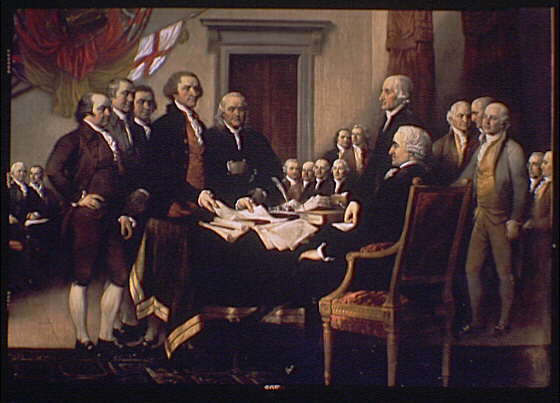
 Balladeer's Blog