
 AN AUTOMATIC ENIGMA (1878) – By Julian Hawthorne, son of Nathaniel Hawthorne. In the past Balladeer’s Blog has reviewed some of Julian’s horror stories, but this time around it’s a sci-fi tale. An Automatic Enigma first appeared under the title The Mullenville Mystery in 1872 before Hawthorne revised it and had it published in 1878 under the new title.
In Mullenville, a traveler named Ned Holland charms Nellie Swansdowne, who is considered the greatest beauty in the area. After a time, Nellie accuses Ned of acting too machine-like, provoking a fierce argument and a breakup. Continue reading
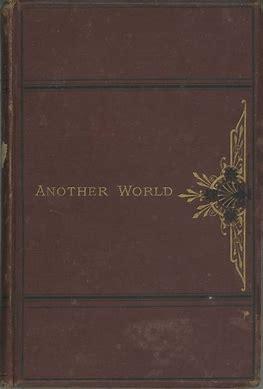 ANOTHER WORLD (1873) – This highly detailed account of life in Montalluyah (“God’s own city”), the capitol city of Mars, was written by British author Benjamin Lumley under the pen name Hermes. The book is presented as excerpts from historical accounts, including a biography of the Great Martian Reformer Tootmanyoso.
 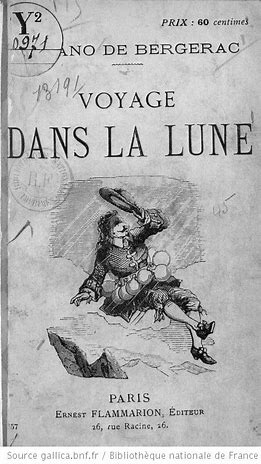 A VOYAGE TO THE MOON (1657) – Written by Cyrano de Bergerac. Yes, the one and only Cyrano de Bergerac, noted for his prominent proboscis and for Rostand’s play depicting his romance with Roxanne, at first acting on behalf of his friend. Some people still mistakenly believe Cyrano was a fictional character.
  Cyrano’s fictional space traveler was named Dyrcona and was the first to use multi-stage rockets to reach his destination. Dyrcona’s rocket design was based on firecrackers of the time period. The lunar inhabitants wore no clothing, had four legs and spoke in song. Their technology included transparent globes that captured solar rays for illumination, talking book-machines (early radio) and ray-guns that not only killed game but simultaneously cooked it.
 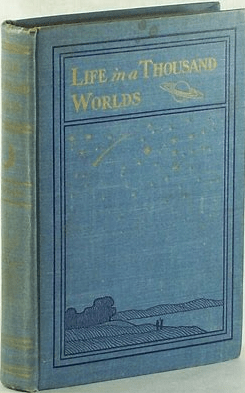 LIFE IN A THOUSAND WORLDS (1905) – Written by William Shuler Harris. This is yet another work of “ancient” science fiction that deals with life on other planets. Each celestial body that is visited gets its own chapter.
  A PESTILENT VAPOR (1903) – Written by Alice MacGowan, this neglected story introduced a figure who should have become as famous in his way as H.G. Wells’ Invisible Man.
 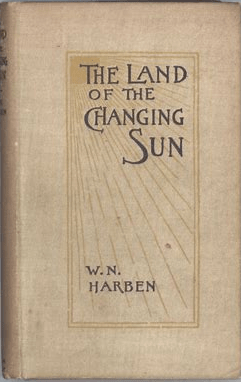 THE LAND OF THE CHANGING SUN (1894) – By William N. Harben, a former American literary giant who has since been forgotten.
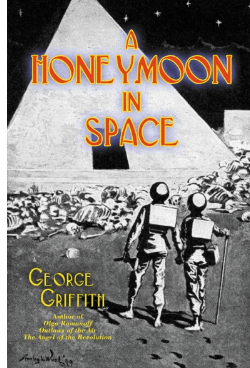 A HONEYMOON IN SPACE (1900) – Written by George Chetwyn Griffith- Jones under the pseudonym George Griffith. Jones had worked as a sailor, a journalist and a teacher before writing a series of novels covering a broad range of topics.
  THE PURPLE DEATH (1895) – Written by William Livingston Alden. Presented in the first person this story is narrated by a British gentleman staying in Italy. He becomes friendly with his neighbor, a German M.D. and bacteriologist named Dr Schmidt.
  DISCOVERIES IN THE MOON (1835) – The full title of this work is Discoveries in the Moon Lately Made at the Cape of Good Hope by Sir John Herschel. Originally published as a series of “real” scientific articles in the newspaper the New York Sun, this hoax was the written-word equivalent of the War of the Worlds radio broadcast of a century later. The series of fraudulent articles caused a sensation and increased the newspaper’s circulation exponentially before the Sun revealed it was all a work of fiction.
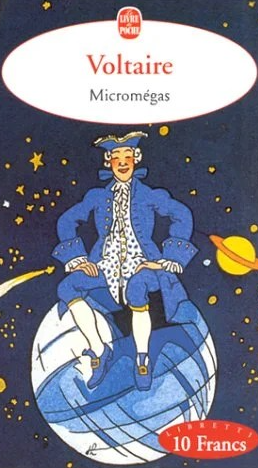 MICROMEGAS (1752) – Written by Voltaire. The famed philosopher’s contribution to the nascent science fiction genre dealt with one of the earliest known instances of beings from other planets depicted visiting the Earth. Amid the fantastic elements of the story Voltaire fits in examinations of the philosophies of Aristotle, Locke, Descartes and others.
 Balladeer's Blog