
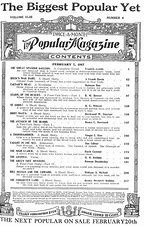
 THE FORGOTTEN LAND (1917) – Written by H. H. Knibbs. This writer was much better known for his poems about the American West. The Forgotten Land ventured into science fiction and “future history.”
This short story began in “the near future” from its publication in the February 7th, 1917 issue of The Popular Magazine. The narrative drops us into the middle of ongoing events. Sometime earlier, Japan invaded the west coast of the United States.
Japan’s armies have been routing America’s armed forces and multiple tribes of Native Americans have seized the opportunity to try to retake much of their land from both the whites and the Japanese. The story’s central character is a railroad official named Jack Hanley. Continue reading
 Konstantin Eduardovich Tsiolkovsky did real-life work crucial to space-flight and is one of the neglected pioneers of Science Fiction. Balladeer’s Blog takes a look at a few of his works.
  These flying plant-people from the Asteroid Belt obtain nourishment through chlorophyll and solar radiation. They also have advanced technology like the harnessing of dismantled asteroids into rings, resulting in lower gravity for manufacturing work.
  OUT OF THE EARTH (1920) – Set in the year 2017 A.D. this tale features what readers are told is the first manned flight to the moon, some 48 years AFTER it happened in real life.
 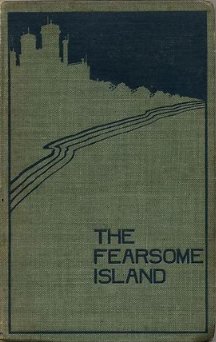 THE FEARSOME ISLAND (1896) – Written by British author Albert Kinross. An unusual work with a multi-layered narrative. The entire novel was penned by Kinross, but it is one of the countless works of fiction presented as if it is a rediscovered manuscript relating the “true” adventures of Silas Fordred from the 1500s. Kinross adds another layer by explaining the sci-fi devices that Fordred could not comprehend and put down to sorcery and the supernatural.
  AFTER LONDON aka WILD ENGLAND (1885) – Written by Richard Jefferies. A post-apocalypse saga in which the shifting of the Earth’s axis has reduced the British Isles to a medieval level with feral animals and pockets of toxic wasteland. There are scattered “kingdoms” and roving bands of marauders but no contact with the world outside the area.
  The Thames and Severn Rivers have backed up, forming a large central lake in England. What was once London is a toxic marsh so deadly to human life that its gases and vapors, when carried by the winds, kill or drive mad humans exposed to them.
  These two works were written by Lucian, the Greek philosopher and satirist who lived in the 2nd century A.D. Lucian was noted not just for his philosophical observations but also for two works that defied definition by his contemporaries but would easily fall into the category of science fiction today. Both works are from roughly 150 A.D. and feature trips to the moon by pseudo-scientific means.
 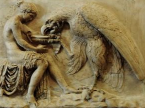 He discovered that the moon (on which he could breathe just like on Earth) was populated by the souls of the deceased (roughly twelve hundred years before Dante’s Paradiso). From the moon Menippus made the astonishing observation that the Earth was round and not flat, in a wry addition to the then-ongoing philosophical debate about the subject.
  THE VIOLET FLAME (1899) – Here is another of the science fiction works written by THE Frederick Thomas Jane, of Jane’s Guides fame. Previously, Balladeer’s Blog reviewed Jane’s works
  GUESSES AT FUTURITY – This was a series of nine full-page illustrations by THE Frederick Thomas Jane, the man behind the Jane’s manuals. He devoted as much attention to detail here as he would go on to do in illustrations of military hardware in later years.
 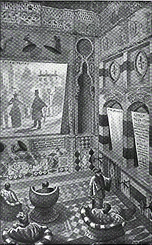 I. HOME LIFE IN ANNO DOMINI 2000 (October 1894) – Jane depicted Brits of the “future” living in homes with very high ceilings. The interior decoration is decidedly eclectic while the wardrobe of these Brits is a kind of retro revival of Medieval clothing.
 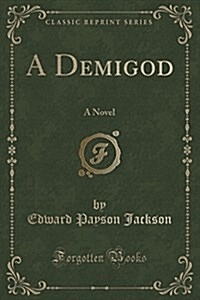 A DEMIGOD (1886) – Written by American author Edward Payson Jackson, this work preceded Philip Wylie’s Gladiator by more than 4 decades.
  THE MILLTILLIONAIRE (1895) – This novel was written by American author Albert Waldo Howard under the pen name M. Auburre Hovorre. A second edition came out in 1898.
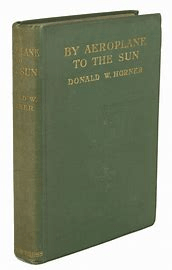 BY AEROPLANE TO THE SUN (1910) – Written by Donald W. Horner. This British novel features ideas that wouldn’t have been out of place decades earlier but in 1910 it’s astounding to encounter concepts like an alleged scientist believing that the sun is inhabited.
  Balladeer's Blog