
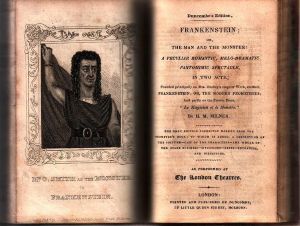
 THE MAN AND THE MONSTER – Written by Henry M. Milner, this stage adaptation of Mary Shelley’s Frankenstein differs significantly from her novel and was first performed on July 3rd, 1826 at the Royal Cobourg Theatre.
The full title of this play is Frankenstein; or The Man and the Monster, a Melodrama in Two Acts. At least one other stage adaptation in 1823 preceded Milner’s version of the story. Milner’s play can be read in its entirety online.
In honor of Rome: Italian Style on SCTV I like to think of this work as Frankenstein: Italian Style since it is set in Sicily, apparently only so that Mt. Aetna can figure in the play’s finale. Rather than laboring in his own castle, Dr. Frankenstein lives and works in Sicily under the auspices of the Prince del Piombino.
The prince is a great patron of arts and sciences, and he finances Frankenstein’s work. In turn, the doctor tutors the prince’s son Julio (Julio?).
Supporting characters include Victor Frankenstein’s servant Strutt; Quadro, the prince’s butler; Lisette, Quadro’s daughter and Emmeline, Frankenstein’s fiancee who has already given birth to one of his children out of wedlock.
The prince is preparing a great celebration in honor of Dr. Frankenstein’s mysterious new breakthrough. Strutt, Quadro and Lisette are so curious about what the brilliant scientist has accomplished in his laboratory that they climb a ladder to reach a height from which they can observe Frankenstein at work.
The doctor paces his lab, congratulating himself with lines like “Tis mine, mine only to breathe the breath of life into a mass of putrefying mortality.” Ultimately, Victor animates his creation through the use of chemicals.
NOTE: It was not until James Whale’s 1931 movie version of Frankenstein that lightning and/or electricity in general became popularly thought of as the means through which the Monster was brought to life. Silent film adaptations which I reviewed previously did not use lightning, either.
When Frankenstein’s Monster rises from its slab, the doctor is horrified by it. He attacks it with a knife and a sword, but the creature’s massive strength lets him easily disarm his creator and break the bladed weapons in half.
 The Monster, innocent and uncomprehending, repeatedly appeals to Victor for affection and understanding but he shows it nothing but disgust and contempt. Frankenstein tries to keep his creation hidden from everyone while he ponders fleeing Sicily.
The curious Monster noses around and winds up getting shot by Emmeline’s father Ritzberg. This proves to be the straw that broke the camel’s back as the misunderstood creature realizes that the others who surround it will never accept it and will try to do it harm.
When the Monster kills the prince’s son Julio, Dr. Frankenstein abandons the option of keeping anything a secret. He confesses to his creation of the creature and invites everyone’s help in dealing with what he has unleashed.
The escaped Monster terrorizes a nearby Sicilian village and eventually manages to kidnap Emmeline’s illegitimate child, seeking to harm its creator in this manner. Frankenstein rallies villagers and several soldiers and leads them in chasing his creature out of the village and into the countryside.
The pursuit leads to the volcanic crater at the top of Mt. Aetna. The Monster is about to hurl Victor’s child to its death but Emmeline appears and soothes the creature with her flute playing, as she had earlier in the play.
The Monster is moved into releasing the child but kills Dr. Frankenstein when he attacks. Surrounded and hopeless, the creature leaps into the volcanic fires of Mt. Aetna to end its tragic existence.
As I mentioned above, the differences to Shelley’s novel are many, but this play proved popular and ran into the 1840s. Several other stage adaptations of varying degrees of faithfulness to the source material followed in the decades ahead.
Ultimately, Peggy Webling’s 1927 stage play Frankenstein: An Adventure in the Macabre was used by Hollywood’s James Whale as his model for the 1931 film, not so much Mary Shelley’s novel.
FOR MORE “ANCIENT” SCIENCE FICTION CLICK HERE.
 Balladeer's Blog
Finding here that Henry Milner created a screen play from Mary Shelley’s Frankenstein — I wonder if there was any relation between Henry Milner and the benefactor who contributed to the creation of Milner Hall (a dorm at Sam Houston State University). Since (in the late 1970’s) I was a undergraduate student at Texas A&M University (a good 35+ miles from SHSU), I won’t say how I am familiar with dorm names there.
But it still makes me wonder.
I’m afraid I don’t know! And I won’t press for the reason behind your knowledge. 😀
Wonderful post as always. I never heard of the ancient science fiction story “The Man and the Monster” before.
I’m always happy to spread the word!
Interesting post! F.y.i. The 1931 Frankenstein movie will be featured on Svengoolie this Saturday night on MEtv. It’s also free on demand on the Nostalgia network. Have a nice weekend!
Thank you very much for letting me know that! I appreciate it! You have a nice weekend, too!
Interesting that the use of lightening/electricity wasn’t an initial part of this story; I had no idea it was chemicals that brought him to life! Fab post btw!
Thank you very much! I appreciate it!
Fascinating and informative; brilliant! Thank you, my friend.
Glad to do it! Thank YOU for such a nice comment.
Your ancient science fiction posts are intriguing.
Thank you very much!