
Christmas Carol-a-Thon 2025 comes to a close with this review of an Italian film adaptation of the Dickens novel.
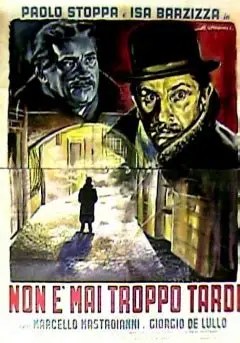 NON E MAI TROPPO TARDI aka It’s Never Too Late (1953) – This is one of the few Italian movie adaptations of A Christmas Carol, so that alone makes it worth seeking out for obsessive Carol fans like me.
And speaking of obsessive fans, if you’re part of Marcello Mastroianni’s well-deserved legion of devotees, DON’T be fooled by the way some ads for It’s Never Too Late make it seem like the Italian actor is one of the stars. He has a very small role but after he became a big name in the industry this flick was hyped as a Mastroianni vehicle.
 The misdirection went so far as to list Marcello’s name above the actual star Paolo Stoppa in the movie’s re-release title A Wonderful Night (Una Notte Meravigliosa).
It’s Never Too Late was directed by Filippo Walter Ratti, who cowrote the screenplay alongside Piero Regnoli. The aforementioned Paolo Stoppa starred as Antonio Trabbi, the movie’s Scrooge stand-in. Trabbi almost redefines “usury” as he ruthlessly exploits the people who come to him for loans, often after huge gambling losses.
Acting-wise, this film is a case of Paolo Stoppa and the Seven Dwarves since he outshines the rest of the cast, even Mastroianni who doesn’t get to do much at all in his role as the man that Trabbi’s lost love married instead of him.
Carol fans will certainly remember how minor a character Belle’s husband is in the Dickens novel, often to the point of not even being given a name in adaptations of the story. Marcello is lucky on that level since his character does have a name – Riccardo.
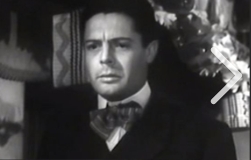 At any rate, It’s Never Too Late is set in early 1950s Italy and we meet Antonio Trabbi as he makes his way to his lending business on Christmas Eve. People regard the man with a certain uneasiness, like Dickens describes Ebenezer Scrooge’s encounters as he makes his way through the streets of London.
The city streets still share space between vehicles and horse-drawn (or mule-drawn) wagons. Those streets feature BIG piles of horse and mule dung. (Insert your own Jeff Goldblum in Jurassic Park joke here.)
If you thought the Jeremy Brett Sherlock Holmes show overdid the horse crap in the streets of London, just wait til you get a look at Italy’s streets in this movie. Anyway, at one point on his walk to work, Trabbi apparently feels it’s too much trouble to go out of his way to avoid a challenging mound of dung, so he roughly knocks down a little boy who was occupying the route our Scrooge wanted to walk in order to avoid it.
In fact, Trabbi is repeatedly physically aggressive with others, which helps him stand out in the sea of Scrooge stand-ins. And as I mentioned above, Paolo Stoppa is the only cast member who avoids fading into the woodwork.
 His timid and browbeaten Bob Cratchit equivalent is portrayed by Giulio Donnini and rather than a nephew, Trabbi has a grandson (Luigi Tosi), whose annual invitations to Christmas Dinner are rudely rejected by our Scrooge figure. The Charity Collectors (above right) are fairly unmemorable.
Trabbi’s day of putting the screws to borrowers in dire straits is made even better by the opportunity to refuse a loan to his long-lost love Rossana (Isa Barzizza). She and the man she married (Mastroianni, if you’ll recall) have fallen into poverty, unlike the happily middle-class Belle and her spouse in A Christmas Carol.
The miser spitefully refuses to even accept collateral in the form of a family heirloom to secure Rossana’s loan. He disapproves her appeal for credit and she goes away in an even more desperate state of mind.
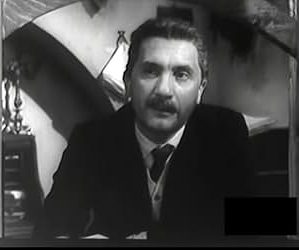 That night, Antonio is visited by the ghost of his dead business partner (Guglielmo Barnabo), who gives him the standard warning about how he has been punished after death and how Trabbi himself will be similarly punished. He can be saved only through visits from the Ghosts of Christmas Past, Present and Yet to Come.
When those visits happen, Antonio tries with decreasing effectiveness to convince himself it’s all just a series of nightmares. The Christmas Ghosts are contemporary Italian versions of the spirits, like a humble youth, a man who walks the late-night, foggy streets and the usual solemn Man of Mystery for Christmas Yet to Come.
Sadly, though the transitions from spirit to spirit have an imitation Cocteau air, the Ghosts themselves don’t have much personality, so as usual Paolo Stoppa carries all the dramatic burden in those scenes. For Christmas Past we are shown Antonio’s hardscrabble youth, in which his younger self is played by Enzo Cerusico, and his eventual estrangement from his lady Rossana, whose younger version was played by Ellida Lorini.
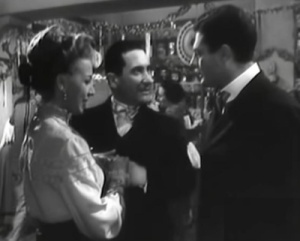 In this Carol the Scrooge figure dumps the Belle equivalent. Riccardo, the man she marries after breaking up with Scrooge/ Trabbi was an active romantic rival for Rossana’s affections all the while. Uh. Yeah. Marcello Mastroianni had to settle for getting a woman on the rebound from her relationship with Paolo Stoppa. Paolo was a great actor, but c’mon. (I’m kidding.)
Christmas Present shows Trabbi the poor but affectionate family of his Cratchit, including his wife (Leda Gloria) who can’t stand her spouse’s employer. The Ghost also shows Antonio the Christmas festivities being held by his grandson and his wife (Susanne Levesy) including a Topper equivalent of sorts in Attilio Dottesio.
The Ghost then shows Antonio the suffering poor in the city. From there, the Ghost of Christmas Yet to Come takes over.
That spirit shows the miser his Earthly fate of dying alone and going unmourned while scavengers steal his belongings. Even worse, Trabbi goes to Hell, where he faces punishment for his lifetime of misdeeds.
 The morning after, Antonio Trabbi goes through the expected Scrooge-ish ways of making amends. He makes a huge donation to the poor, bails Rossana and Riccardo out of their perilous financial situation and brings gifts to his Cratchit equivalent.
After all that, Trabbi spends the rest of Christmas Day with his grandson, his wife and their guests. Then comes a preachy stretch of narration about the need to turn away from greed and help others and become more godly. It doesn’t ruin the movie but it stands out as heavy handed, like the filmmakers felt we were too stupid to understand the story’s point.
It was certainly interesting to see a Carol which features the Belle character at the end but does not put her back together with our Scrooge figure. I found it more meaningful to have him instead selflessly bestow some happiness on her and her husband.
It’s Never Too Late is an interesting change of pace when it comes to adaptations of A Christmas Carol. It’s definitely worth watching but I found myself wishing the supporting players tried even half as hard as star Paolo Stoppa. Like Cicely Tyson in Ms. Scrooge, Stoppa is virtually alone in carrying the show.
*** Well, that wraps up another Christmas Carol-A-Thon! Be here the Friday after Thanksgiving when the 2026 edition begins. FOR MORE VERSIONS OF A CHRISTMAS CAROL CLICK HERE: https://glitternight.com/category/a-christmas-carol-2/
 Balladeer's Blog
Merry Christmas! Ciao!👋👋😊☃️🎄
Merry Christmas to you, too!
Pingback: AN ITALIAN CHRISTMAS CAROL – NON-E MAI TROPPO TARDI (1953) – El Noticiero de Alvarez Galloso
Logged, and Merry Christmas, sir!
Lovely!
Merry Christmas to you ✨
Thank you! Same to you!
🙏💫🙏
😀
Blessed Christmas ❄️🎄❄️
Thank you! The same to you!
Merry Christmas !
Thank you! The same to you!
Interesting post as always.
Thank you.