
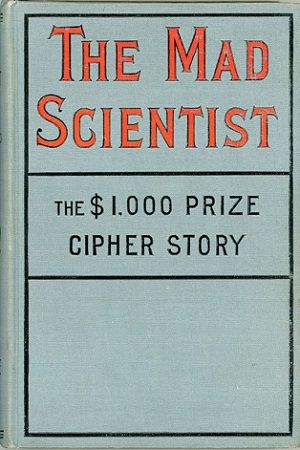
 THE MAD SCIENTIST: A TALE OF THE FUTURE (1908) – Written by Raymond McDonald, a pen name for two Canadians – Raymond Alfred Leger and Edward Richard McDonald. An unusual aspect of this novel was the publisher’s offer of a thousand-dollar reward for any reader who deciphered and provided the best breakdown of a coded message in the story.
Despite being penned by two Canadians, this tale is set mostly in the United States of the near future. An interesting benefit to authorship by two non-Americans of the time is the rare objectivity they bring to issues like labor vs management, socialism vs capitalism and both the creative AND destructive aspects of scientific progress.
The Mad Scientist: A Tale of the Future inspires genuine examinations of all sides of those subjects and doesn’t devolve into a simplistic “good guys vs bad guys” narrative until dramatic necessity demands it in the finale.
The title character is Maxim Folk, a scientific genius who embodies the cliche of pushing so hard to show how he can do something that he neglects to ask IF he should do it. His work in the properties of electricity, matter and light waves is decades ahead of his colleagues.
The obstacles imposed on his research by short-sighted financiers and the scientific establishment drive him into the arms of socialists and violent labor movements. With their assistance Maxim Folk strikes first at William Bell, a consummate capitalist and crooked stock market manipulator. Folk’s inventions enable himself and his confederates to sabotage Bell’s corporate interests for daring to frustrate him.
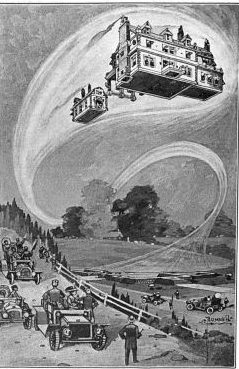 Emboldened, Folk anonymously expands the scope of his activities. The news media report on a New York home which flew off to a new location in Illinois and on a thief who walked through the walls of a bank and made off with $200,000 (equal to $6,952,000 here in 2025).
Next, walking through walls to crash a meeting of Wall Street bigwigs, an unknown figure goes full Neil Breen on their asses. He makes it clear to all of those assembled that he has detailed evidence of their corporate wrongdoing and he will expose them all unless they enact honest business practices.
The above-mentioned tycoon William Bell recognizes all of this as the activities of Maxim Folk, whose funding he denied. Bell realizes that with the funds from the bank robbery Folk can finance even more of his projects.
William hires an accomplished private investigator called Detective Egan, no first name ever given in the novel. Egan’s investigative skill is such that, even though Bell has withheld information about his own unscrupulous business practices, the detective uncovers them.
After some attention is paid to the way Bell and his ilk are just as much criminals as Maxim Folk is, we move on to William Bell hiring the brilliant Professor Alpheus Kaye to work with Egan. Kaye may be second only to Folk in scientific genius, but it’s a very distant second.
Kaye, like Egan, recognizes that the vested financial interests employing them are by no means on the side of justice, but they do not pose the immediate danger that Folk does. Egan and Kaye’s investigation of Folk reaches a dead end when his deadly security systems thwart their attempts to break into his laboratory.
Irked by Egan and Kaye’s efforts, Folk comes out into the open just long enough to abduct the pair in his high-tech futuristic auto and drive them to a pond in upstate New York. Once there, Maxim proves to his foes that he alone has rediscovered the secrets of Greek Fire, which can burn on water and is inextinguishable through liquids.
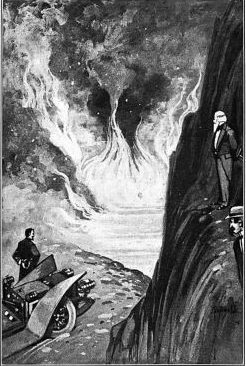 He sets the entire surface of the pond ablaze, and warns Detective Egan and Professor Kaye that if they continue opposing him he will use his Greek Fire to set the Atlantic Ocean on fire, bringing eastern shipping to a standstill among other disasters.
Our heroes back off for a time but eventually Egan summons all his resources to shadow Maxim Folk and follows him to Washington DC. Maxim uncovers secrets on the part of politicians in the highest offices – even fictional President Cassell. Using a “telephotocamera” Folk manages to copy documents which reveal the ugly conspiracy at work.
The Big Money powers in the United States have joined forces with the current administration to sign a secret treaty with Germany. The corporate and governmental powers so fear a labor uprising and so distrust America’s own military to support the government that a German army will be permitted to enter the U.S. to put down any monumental labor violence.
Folk provides copies of the documents to his allies in the nationwide labor movements. All moderates in those movements are shamed into silence by the secret agreement between the administration and the Germans. Labor plans a march on Washington so large it would put Coxey to shame.
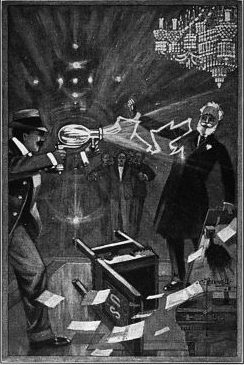
Something that big can’t be kept a secret for long, and William Bell’s other detectives get word to him about the march. He meets with Detective Egan to discuss this with him but Maxim – who has now mastered invisibility – shows up at the meeting and kills Bell with an electricity weapon.
Folk leaves after believing he killed Egan as well, but the detective survives thanks to a special suit designed for him by Professor Kaye. While Egan recovers over the course of days, Kaye devises a method of detecting when the natural forces manipulated by Folk’s advanced science are disturbed.
This lets our heroes learn that Maxim has manufactured large glass projectiles which can convey enormous electrical shocks on anything they are fired at. Meanwhile, 500,000 laborers arrive in Washington DC on their march.
The powers that be, anxious to see if American troops will obey orders to fire en masse upon their fellow citizens, launch an attack by federal troops that kills thousands of the marchers. This merely plays into Maxim Folk’s hands, however.
 Folk now distributes thousands of his electrically charged glass projectile weapons to the laborers. The workers’ army uses the futuristic devices to literally slaughter the federal troops to the last man as well as several political figures.
Neither the labor leaders nor the Washington politicians are as amoral as Folk is, however. Both sides join the general populace in being shocked and appalled at the incredible loss of life. The workers’ army disperses and the politicians order newly arrived federal troops to take no further action against them.
The already unbalanced Maxim Folk lapses even further into insanity in his frustration over this peaceful development. His influence with national labor movements waning after the Washington massacres, Folk uses his invisibility and electrical weaponry to individually assassinate several of America’s wealthiest capitalists.
This fails to reignite the violence by either side so Maxim decides that if the great mass of workers will no longer fight, he might be able to tap into religious fundamentalism to bring on civil war. Folk has one of his agents pose as a fire and brimstone preacher in Chicago.
The rabble rouser inflames passions around the country with his religious rhetoric and his display of “miracles” which are secretly carried out via Maxim’s advanced technology. Amid this new chaos and violence, Detective Egan and Professor Kaye fake their own deaths to trick Folk into letting his guard down.
NOTE: As events accelerate toward a conclusion, moral ambiguity falls by the wayside, apparently from dramatic necessity as conceived by our Canadian authors. Maxim Folk has no more sympathetic traits and is stripped of his pretense of idealism.
Readers see that the villain only sided with labor and socialism because the forces of management and capitalism blocked his ambitions at the outset. If the plutocrats and the government had helped further Folk’s research, he would have allied himself with them instead.
Back to the story, Egan and Kaye’s gambit of playing dead succeeds and Folk is drawn out into the open to strike at a fake gathering of tycoons on a ship in Lake Michigan. The vessel is attacked by the villain and his forces.
Maxim is captured and put on trial, but the trial is disrupted by the mad scientist’s phony religious leader and his army of devotees. Folk escapes and soon leads a raid to hijack the American battleship Behemoth.
He and his men take to the high seas, preying on global shipping, using Folk’s high-tech weapons on offense and his new force field technology on defense. Ultimately, enough battleships from all nations manage to surround the Behemoth at sea.
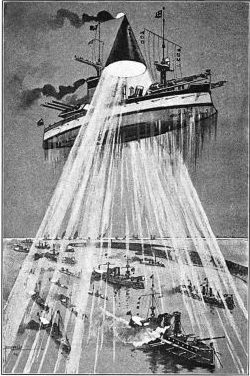 Maxim Folk now reveals the full depth of his scientific genius. He activates antigravity technology and the behemoth flies off, its force field protecting it from the artillery let loose by the allied ships.
The Behemoth flies to New York City and symbolically begins unleashing its weapons on Wall Street and vicinity. The maddened Folk apparently had neglected to note that an eclipse was about to occur. The eclipse interferes with the functioning of Maxim’s inventions, causing the Behemoth to plummet to the streets below, killing Folk and his troops.
*** Okay, I certainly don’t deny the obvious influence of Griffith’s The Angel of the Revolution on this novel. However, I think the Canadian writers managed a unique distillation of the major forces at work in the land.
Readers saw money, governmental power, organized labor and religion as baldly competing forces for much of the novel, with science morally neutral but open for exploitation by any of those competing forces.
Ultimately, lines were drawn by Maxim Folk’s own excesses and his downfall came not from his enemies but from higher powers, whether a reader prefers to think of them as science & nature or Divine Intervention.
For a 1908 work The Mad Scientist: A Tale of the Future exceeded expectations in my opinion.
FOR MORE “ANCIENT” SCIENCE FICTION CLICK HERE.
 Balladeer's Blog
Pingback: THE MAD SCIENTIST: A TALE OF THE FUTURE (1908) ANCIENT SCIENCE FICTION – El Noticiero de Alvarez Galloso
Logged, thank you sir!
Just amazing; thank you!
Thanks and thank you for such a nice comment, friend!