
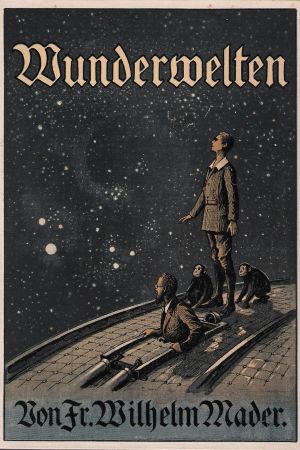
 WONDERWORLDS (Wunderwelten) (1911) – Written by Friedrich W. Mader. This novel was published in its native German in 1911 but not translated into English until 1932 under the title Distant Worlds. Some sources mistakenly list 1932 as its original year of publication.
Wonderworlds is basically what we today call Steampunk. Lord Charles Flitmore has had a spaceship constructed in the form of a large globe which works via antigravity.
Flitmore puts together an expedition to explore the solar system. Members of the expedition include his wife Lady Mietje Flitmore, biologist Professor Heinrich Schultze, Hans Friedung, Schultze’s protege, Johann Rieger, Flitmore’s manservant, and Captain Hugo von Munchhausen, a fat, boastful liar who is a comic relief figure in the mold of the fictional Baron Munchhausen.
Flitmore’s spaceship, called the Sannah, takes off on its expedition, with two monkeys named Dick and Bobs along for the ride. The Sannah first visits the moon, where our explorers discover that the Dark Side is unexpectedly vibrant with life. There are lush forests and ample sources of water.
From there it’s on to Mars, which is covered with red vegetation. Our explorers discover that what Earthlings thought were canals were just optical illusions. The planet is filled with hostile life forms, and our heroes are attacked by giant insectoid creatures and huge worms.
The Earthlings encounter an elderly Martian who is the last of his race. The rest of his people were wiped out by Mars’ frequent earthquakes.
The Sannah travels on to the Asteroid Belt, where they land on an asteroid which they name Tipekitanga. It has no intelligent life but has an Earth-like atmosphere and environment and is covered with colorful minerals.
Jupiter is discovered to be enormous but gaseous. Saturn is solid and can be explored. Its surface vegetation is spongelike but this planet, like Mars, is inhabited by gigantic insect-like creatures.

BALLADEER’S BLOG
Our characters depart Saturn and get carried along by a comet which travels at several times the speed of light. And if you think that’s scientifically impossible, you haven’t seen anything yet. Read on.
In a few weeks the Sannah reaches the star Alpha Centauri. Our crew is running out of oxygen but when the hull is damaged by a passing meteor oxygen rushes in, since the spaceship somehow carried it along with it.
The explorers land on a lush planet they name Eden for its perfect temperature and abundant wildlife. They encounter humanoids who are a bit smaller and weaker than Earthlings and have achieved a High Civilization.
We readers are told that communication is made possible via what Mader calls “root sounds” common to all intelligent life. Uh. Yeah. The Edenites live for the equivalent of over 3,000 Earth years and their eyes work like telescopes. They can see Earth from Eden.
The aliens also have additional lungs which can breathe in lighter than air gasses which allow them to fly. Hans Friedung and a female Edenite fall in love with each other and she joins the crew for their return trip to Earth.
The Sannah stops off at a formerly unknown planet which is so dark it has evaded discovery by Earth astronomers. An explosion in space sends the Sannah hurling toward our sun but it manages to survive and the crew land safely in South Africa.
Wonder Worlds is the only Friedrich Mader novel translated into English so far. It’s fun but juvenile and its science seems very out of date even for 1911. Mader’s other works involve adventures and fables, so apparently science was not a subject he studied in depth.
FOR MORE “ANCIENT” SCIENCE FICTION CLICK HERE.
 Balladeer's Blog
Impressive
Thanks
Pingback: WONDERWORLDS (1911) ANCIENT SCIENCE FICTION – El Noticiero de Alvarez Galloso
Logged, thank you sir!
I love this series!
Thank you very much!