
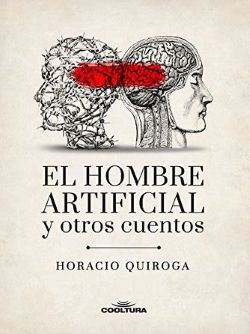
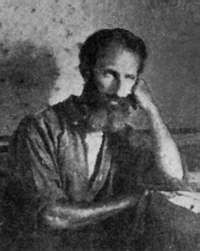
 EL HOMBRE ARTIFICIAL (1910) – This story was written by Uruguayan-born writer Horacio Quiroga under the alias S. Fragoso Lima. Quiroga moved to Argentina in 1902. Upon being diagnosed with stomach cancer in 1937 he committed suicide.
This particular tale was serialized in Argentina’s weekly publication Caras y Caretas from January 8th to February 12th, 1910.
The artificial man of the title is the work of three scientists. The leader is Nicholas Ivanovich Donisoff, a Russian prince who rebelled against the Tsarist regime and traveled in revolutionary circles. He was eventually forced to flee Russia and became renowned in the field of biochemistry.
The second scientist is Stefano Marco Sivel from Italy. When he was very young, Stefano ran away from home due to his brutal father. His brilliant mind fueled his rise to scientific prominence and wealth. Sivel was so dedicated to his experiments that it drove a permanent wedge between him and the woman he loved.
The third scientist is Ricardo Ortiz of Argentina. After studying in America he returned to Buenos Aires and became THE authority on electrical engineering. His obsession with science alienated him from his family and when his father passed away he rejected his inheritance.
 We readers are told that the trio gathered together in Buenos Aires in the autumn of 1906. For the next three years they worked on creating an artificial being, but not a robot. Their creation would be the product of biochemistry and bioelectricity.
Marshaling the building blocks of life our scientists started small, first creating an artificial rat. Learning from that experiment’s shortcomings regarding blood and bone tissue, Donisoff, Sivel and Ortiz moved on to create an artificial male humanoid. They name their creation Biogeno.
Though Biogeno technically “lives” he is like a person in a coma and has no consciousness. At last, out of desperation, Donisoff abandons his ethics and lures a vagrant to the laboratory to use as a human guinea pig.
Hooking up the homeless man to Biogeno, Donisoff tries to “jump-start” the artificial man’s consciousness through the primal feeling of pain. The Russian subjects the vagrant to unspeakable torture and though Biogeno often mirrors the agonized reactions of the victim whose sensations he shares he does not gain independent consciousness.
Donisoff perseveres in his cruel efforts and at last animates Biogeno into independent thought and movement. Unfortunately, the artificial man has been so imprinted with the vagrant’s pain that every physical sensation to Biogeno is perceived by his brain as agony.
The vagrant mercifully dies, so Donisoff offers himself as a new guinea pig to his intimidated collaborators Sivel and Ortiz. Under the Russian’s guidance the trio link him up with Biogeno like the late homeless man had been.
 Donisoff plans to try siphoning off some of Biogeno’s pain by suffering it himself. Sharing the torment awakens something in the artificial man but as he reaches out and touches Donisoff, both of them die.
El Hombre Artificial is not quite a classic but I found it very impressive. The tale definitely motivated me to track down and read more of Horacio Quiroga’s stories.
FOR THE AMERICAN SHORT STORY TITLED THE ARTIFICIAL MAN (1884) CLICK HERE.
FOR MORE “ANCIENT” SCIENCE FICTION CLICK HERE.
 Balladeer's Blog
Pingback: EL HOMBRE ARTIFICIAL (The Artificial Man) (1910) ANCIENT SCIENCE FICTION – El Noticiero de Alvarez Galloso
Logged, thank you sir!
Oh no 🥺The stories of the scientists attracted me, especially the last scientist who told the story of the experiments. Thank you for participating. My best wishes and prayers to you, Edward.
Thank you very much! Same to you!
😍🙏🏻👋🏻
😀