
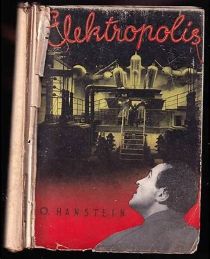
 ELEKTROPOLIS (1928) – By Otfrid von Hanstein. Readers are introduced to Fritz, a young German engineer who has been having trouble finding a job. On what turns out to be a lucky Friday the Thirteenth for him, he gets a job offer from a mysterious Mr. Schmidt.
The pay is too good to turn down, but Fritz is sworn to secrecy and must abide by certain other peculiar terms. The engineer loves the money and is increasingly intrigued by the mysterious circumstances.
Fritz does as instructed and is taken to Australia, part of the way via a high-tech airplane which has no pilot and is completely automated. Similarly, once in Australia he boards a fully automated train which takes him to a cluster of iron huts in the desert of the Australian Outback.
At last, Fritz meets his new employer, who identifies himself as Mr. Schmidt, his long-lost uncle. It turns out Schmidt was once a pupil of the brilliant Wenzel Aporius, “the German Edison” and a pioneer in the field of robotics.
NOTE: Wenzel Aporius was a character in an earlier science fiction work by Otfrid von Hanstein, The Farm of the Lost (1924). That novel depicted Aporius’ high-tech colony in the Mexican jungle run mostly by machines – an experiment that ended in failure and with Aporius sent to an insane asylum.
In the grand tradition of such scientists, Mr. Schmidt feels he can avoid the mistakes and mishaps that doomed his former teacher. Schmidt shows Fritz an underground cavern where he discovered an enormous deposit of radioactive material, much of which he mined and sold for a fortune.
With that fortune, Schmidt got the Australian government to sell him the huge tract of desert landscape above the radium deposit. Fritz is told that the radium comes from a gigantic meteor which crashed in the Outback long ago and penetrated beneath the surface.
There are hints that it may actually have been an alien spacecraft that crashed, given what looks like odd writing and other signs of futuristic technology being involved.
 At any rate, the genius of Schmidt and Fritz works wonders in the months ahead. They create mechanoids to build a city and invent rain-making tech that turns the stretch of land owned by Schmidt into lush greenery and fertile farmland.
In a story element that was way ahead of its time, Schmidt makes peace with the Aborigines, who flock to his side because of his respect for their autonomy. They are free to become part of his super-scientific city if they choose, or they may live under their old ways in a section where the Australian government cannot harass them since it is part of what belongs to Schmidt.
The Teutonic Technocrats welcome in swarms of arriving Germans to live in this “Elektropolis.” The Australian government grows wary of the threat posed by the settlement’s advanced science and envious of the way Schmidt and Fritz have turned arid desert into a virtual paradise.
Aussie politicians use legal sophistries to invalidate Schmidt’s ownership of the land and have their army try occupying Elektropolis. The people aren’t having it and use gamma-ray guns invented by our heroes to drive off the Australian military.
The army then tries subjecting the city to an artillery bombardment, but the Dynamic Deutschlanders have devised a force-field which annihilates all the shells before they can do any damage. The Aussies abandon their attempts to take Elektropolis by force.
In the ensuing five years, the futuristic colony thrives, having achieved a perfect balance between technology and nature as well as peaceful coexistence with Australia’s indigenous people.

BALLADEER’S BLOG
I found Elektropolis to be a refreshing change of pace from the expected “robotic creations eventually run amok” storyline. The peace carved out with the Aborigines and the message condemning the treatment of indigenous peoples around the world was another nice touch.
As for the “meteor”, readers get even more reason to believe it was really an ancient spaceship before the novel is over. I wish von Hanstein had instead saved that whole “ancient aliens/ underground civilization” concept for a separate novel rather than waste it as a virtual afterthought in Elektropolis.
FOR ANOTHER FUTURISTIC CIVILIZATION FOUND IN AUSTRALIA IN AN 1837 NOVEL CLICK HERE.
FOR MORE “ANCIENT” SCIENCE FICTION CLICK HERE.
 Balladeer's Blog
😲
Ha! My facial expression exactly!
Pingback: ANCIENT SCIENCE FICTION: ELEKTROPOLIS (1928) – El Noticiero de Alvarez Galloso
Logged, thank you sir!
Great ancient science fiction story. I have never heard about this story before but found it quite interesting. The robot AI aspect of the story brought to mind great science-fiction movies which I love. For instance, the story reminded me a lot of the classic sci-fi movie “Blade Runner”. Ridley Scott’s movie has stood the test of time as a classic. It has similar themes to the ancient science fiction story you shared here. For this reason, I would like to some day see “Elektropolis” be made into a movie. It definitely could make for a great movie in the vein of “Blade Runner”.
Here’s why I recommend “Blade Runner” if you haven’t already seen it:
Thank you! I agree, Blade Runner is very enjoyable!
I love all the visions of the future, especially over time.
I feel the same way!
❤
Thank you!
I hope you have a wonderful week, Edward. Good night
Thank you! The same to you!