
 CONVERSATIONS ON THE PLURALITY OF WORLDS (1686) – Written by Bernard le Bovier de Fontenelle. The author offered up some science fiction concepts that were considered real possibilities in 1686. These ideas were presented within the frame of conversations, as indicated in the full title. The conversations happened over the course of six evenings.
FIRST EVENING – Bernard presented these conversations as taking place during flirtatious evening walks with a fictional Marchioness based on his real-life female acquaintance Madame de la Mesangire of Rouen. Due to the time period, she had not been educated in the sciences and Fontenelle needed to introduce her to certain concepts from the ground up.
This first evening found him explaining what 1686 science knew about the rotation of the Earth and the Earth’s revolution around the Sun. An interesting, outdated element of the conversation came in when Bernard discussed what some scholars of the time apparently believed – that space was not a vacuum but was made up of “celestial fluid” in which the Earth and certain other bodies moved.
NOTE: Obviously that theory is incredibly wrong, but it put me in mind of modern speculation on the nature of dark energy and dark matter.
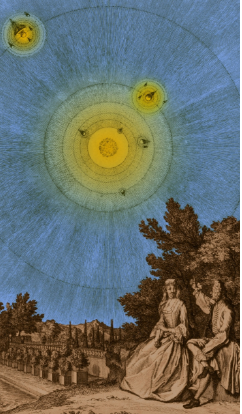 SECOND EVENING – The next day the Marchioness entertained Fontenelle and other guests by day. After dark they resumed their conversation during another evening stroll. Impressed by how thoroughly she had retained the previous night’s concepts, Bernard moved on to new territory.
In his intellectual circles, supporters of the belief that the moon was inhabited felt the moon people were as ignorant of life on Earth as most Earthlings were of life on the moon. The moon people were perceived as being possibly as scientifically advanced as Earthlings and may have worshipped the Earth as some peoples had worshipped the moon.
Fontenelle even speculated that moon people might have superstitious explanations for eclipses like various people across the Earth did. Bernard’s friends were among the amateur astronomers whose view of the moon via telescopes revealed what they considered seas and mountains like we have on Earth.
The author presented the moon’s inhabitants as having no resemblance to Earthlings but offered no specifics. He foresaw a time when communication would be opened between Earth and the moon. That people of both bodies would be able to travel back and forth the way Earthlings traveled between Europe and the Americas.
THIRD EVENING – The next day his hostess wanted Fontenelle to resume their talks but he postponed them to the evening, when he said the sight of the moon and stars above provided the appropriate atmosphere. (He probably claims he runs out of gas, too.)
That night the Marchioness pondered what would happen if the moon people reached Earth first, perhaps in the nature of a crash-landing by a moon ship. The adventurous lady even said she would find it exciting to be abducted by the moon people so she could learn more about them.

BALLADEER’S BLOG
Bernard moved on to describe the lack of clouds on the moon, but his female companion retorted that the moon people might prefer it that way because they did not have to suffer lightning storms like we on Earth do. Fontenelle felt it might mean that moon people lived in caves or beneath the surface to get relief from the sun.
Next, Fontenelle moved on to defend the notion of life on other planets by comparing it to the previously unknown life forms that microscopes were revealing to scientists. Without attributing certain life forms to specific planets (yet) our author proposed a planet where creatures communicated by gestures instead of words.
On other worlds might live beings dominated by barbaric raiders and plunderers. On another might live a race which spawns only one female per generation, and that female, like a queen bee on Earth, might give birth to the entire next generation.
Bernard ended the third evening’s conversation on speculations that other planets may hold large life forms which had life cycles in which they metamorphosed from one form into another, like butterflies.
FOURTH EVENING – On this night Fontenelle and the Marchioness discussed particular planets and their inhabitants. Venus was peopled with beautiful, incredibly eloquent and intelligent humanoids. The woman felt that Venus’ greater closeness to the Sun meant that Venusians had darker complexions than Europeans.
On Mercury lived very dark-skinned people that Bernard ignorantly claimed must be as unthinking as he erroneously believed Africans to be. The closeness to the Sun made the Mercurians so mad from the heat that they were savages. Rivers of molten gold, silver and iron flow across Mercury’s surface.
 Mars, unexpectedly, was depicted as being inhabited only by birds that glowed in the dark because they ate phosphorous. Jupiter and its system of moons were thought of like an Earthly empire. Jupiter was the homeworld of a great conquering race, while each of its moons had been colonized by Jupiter’s inhabitants and subject to their laws.
Regular travel was made between Jupiter and its moons through unimaginable means, yet astronomers on Jupiter and its satellites had no knowledge about life on Earth, the moon, Mercury or Venus.
Saturn was provided with most of its light by its set of rings according to Fontenelle. The beings of Saturn moved very slowly through their incredibly cold atmosphere and their thoughts moved even more slowly.
FIFTH EVENING – The Marchioness theorizes that stars are each individual suns with their own planets revolving around them and Bernard agrees. Some star systems feature planets of various sizes while other stars are orbited by planets of uniform size.
Others still are surrounded by planets which orbit around them from a great distance with no such things as inner planets. The stars of the Milky War are depicted as being very close together with enormous birds which can fly between those stars and the planets which orbit them.
Beings beyond imagining and of incredible size inhabit those regions of space and use the interstellar birds the way we of Earth use carrier pigeons, to communicate with each other.
 SIXTH EVENING – The next evening Fontenelle learned from the Marchioness that other male visitors were convinced that he was filling her head with a bunch of nonsense. He replied with a recap of the notions discussed on the previous nights but in very fine detail. Unfortunately, those details about planets and even clocks (?) were very wrong and not even entertainingly wrong.
As confirmation of the flirtatious (at least) nature of Bernard’s and the Marchioness’ evenings together, he took leave of her for a time with the words “I only ask as a reward for my trouble that whenever you see the sun, the sky and the stars you will think on me.”
Conversations on the Plurality of Worlds is a lot of fun with the slightly flirty, “battle of the sexes” bickering between Fontenelle and the Marchioness providing much of the charm.
That charm is necessary because, sadly, for every set of paragraphs in this work that features imaginative looks at life on other worlds, there are even longer sets of paragraphs rehashing basic scientific principles that 21st Century people learn in school.
This is unavoidable given when Conversations on the Plurality of Worlds was written. Modern readers may find the islands of interesting material not worth the oceans of very simple science.
Comically enough, I couldn’t help thinking that this book might work today as a stage musical like Cats or Sunday in the Park with George or other such unlikely seeming subjects for the stage.
FOR MORE “ANCIENT” SCIENCE FICTION CLICK HERE.
 Balladeer's Blog
G’ day all! When I first read the title I thought it was commentary on Leibniz Best of All Possible Worlds. Voltaire wrote Candide as a cynical response to Leibniz.
As usual I was way off! 😉
Take care my friend!
Hey, that was a reasonable expectation, actually! You take care, too, pal!
🌎🌗Wonderful participation, dialogue, and exciting imaginations between the inhabitants of the Earth and the Moon
Thanks! I agree!
🌎A wonderful imagination of the inhabitants of the Earth And the inhabitants of the moon 🌗
Thank you! I agree!
💛
Thanks!
Great ancient science fiction stories as always. I have never heard about this story before but as always found your post extremely engaging. It brought to my mind great science fiction movies about space travel that I have seen. For instance, the story reminded me a lot about spectacular science fiction movie “Interstellar”. Christopher Nolan’s film captured an astronaut embarking on a journey of space travel leaving behind his children he loves dearly. Matthew McConaughey at his best. One of my favourite science fiction films of all time. Definitely worth seeing if you have an interest in science fiction stories.
Here’s why I recommend it highly:
I really appreciate the kind words! I too like Interstellar.
“Celestial fluid” I love that phrase!
Great read and one that captures lots of emotion. I can only imagine how strange it must have felt living in a time before space travel. I guess this is a reminder of how lucky we are to know so much about the stars. Alternatively, how little as well?
Thanks! Yeah, “Celestial fluid” is as fun as those 1700s sci fi books that called what we know as black holes “Space Whirlpools” instead. I agree about how we know much more but still far too little!
You ought to take a look someday at Catherynne M. Valente’s novel Radiance, which postulates that the solar system really is like this; all the planets are habitable and close enough together that you can travel between them via rockets or even (if I remember correctly) shells fired from giant cannons. It’s a very strange book, and formatted oddly as snippets of letters, screenplays, newspaper clippings, etc., but it manages to build up quite a head of steam by the time it’s finished.
Thanks for the recommendation! Sounds pretty interesting.