
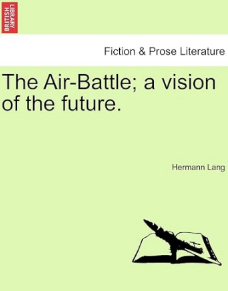
 THE AIR BATTLE: A VISION OF THE FUTURE (1859) – Written by an unknown author using the name Herrmann Lang. (Ignore the misspelling on the cover to the left.) Speculation has it that the author was British despite the German pseudonym and despite the narrator’s claim that he is a black man.
Before you jump to conclusions about how the narrator will be depicted to readers, let me make it clear that this novel has been confounding expectations for well over a century and a half now. The story is set in the year 6900 A.D. White civilization has fallen while three black and mixed-race nations are the dominant powers of the world.
Much of the storyline deals with a war among those dominant powers to end slavery because black Christians strongly oppose that grotesque institution. In 6900 we are told that only white people are used as slaves and the war is being waged to free them. And yes, The Air Battle: A Vision of the Future really was published in 1859!
Now, let’s take a look at the events that led to the state of the world in the 70th Century.
The novel’s narrator informs readers that from the 1870s onward the British Empire and the increasingly influential United States dominated the entire rest of the world. Around the year 1900 scattered tectonic catastrophes altered the world forever.
All of Ireland and nearly all of Great Britain fell beneath the waves. South America was so transformed that Brazil had become an island and to the north the Isthmus of Panama also became submerged.
The United States was reduced to disparate, smaller nations and lost its influence forever. Europe, too, was laid low and the global balance of power shifted not just from white and Asian races to black and miscegenated peoples, but from the Northern Hemisphere to the Southern.
The three great powers in 6900 A.D. are Brazilia, centered around what is left of South America; Sahara, the second of the great black powers, consisting of most of Africa; and Madeira, composed of light-skinned dark people – the result of centuries of mixed white and non-white marriage.
The formerly dominant white nations are so powerless in the post-apocalyptic world that the Big Three have spent hundreds of years raiding them for white slaves and plundering their natural resources.
Brazilia, Sahara and Madeira have very advanced technology while the Northern Hemisphere languishes in a backward, almost primitive state. The Big Three have fleets of aircraft that can carry thousands of troops as well as advanced weaponry. They also use SUBMARINES and incredibly powerful explosives.
We readers learn that those great powers have mastered new types of fuels and energy but no details were offered. Remote-controlled superweapons and reverse suction air pumps are in wide use.
The vast nation of Sahara is the most forward-thinking of the rival superpowers and its king wants to end slavery even for white people. Ending wars with the other two powers is also a priority for him.

BALLADEER’S BLOG
One of the main characters is a white woman named Brunehilda and she at one point seeks political asylum in Sahara. She does this to escape the oppressive government of southern England, all that is left of the once-great nation.
Jonas, the tyrant of the remains of England, is the main villain of the novel. Despite the impressive futuristic thinking of most of the book, Jonas is Jewish and embodies every anti-Semitic stereotype of the 1850s.
The Irish are also despised, and their extinction is thought of as a net gain for the world. While a reader’s mind comes to grips with the unexpected ugliness which has suddenly entered the narrative, a distraction comes in the form of an isolated island nation inhabited by … blue-skinned people.
At any rate, Sahara’s vision for the world order is opposed by Madeira and Brazilia and Sahara’s plan to abolish slavery ignites a massive war among the Big Three. Brazilia is knocked out of the war first, and eventually Sahara triumphs over Madeira. The climactic battle pitted air fleets of thousands of war machines against each other.
Slavery is outlawed, intermarriages among whites and blacks are heavily encouraged, and the advanced nations adopt a policy of letting what is left of Europe and North America try to catch up to the southern hemisphere in technology and civilization.
Sangaree Colo, a black military genius of the Saharan forces, is killed during the war, while Carthagon, a black political figure from that nation turns around Sahara’s fortunes and leads it to victory. Jakadox, a young man from Sahara who discovered the island of the blue skinned people, had afterward gone to the island of England and engineered the fall of the evil Jonas.
Brunehilda marries a high-placed black man in Sahara, while Harold, a supporting white character, marries a black woman named Coronata. Jakadox weds a white English woman.
The major downside to The Air Battle: A Vision of the Future is the fact that the author was, sad to say, not a very good writer. They were great with ideas, but their writing made the storyline vague and contradictory at times.
If parts of my synopsis seem illogical that’s a reflection on the book’s sometimes-jumbled narrative. Obviously, though, this novel is more than worth reading for the unexpected story elements that an 1850s writer fearlessly explored.
FOR MORE “ANCIENT” SCIENCE FICTION CLICK HERE.
 Balladeer's Blog
Great posts as always. I haven’t heard about this ancient science fiction story before but as always found your post extremely engaging. The story “Air Battle: A Vision of the Future” reminded me a lot of great movies about slavery that I have seen. The themes of slavery in the story brought to mind the movie “12 Years a Slave”. Steve McQueen’s Oscar-winning movie paints a powerful portrait of slavery. One of my favourite films of all time. It’s the most realistic depiction of slavery in the 1800s that I have ever seen. It shares similar themes to the ancient science fiction story that you discussed here.
Here’s why I recommend the movie:
Thank you! And your review of that movie was great!
Lulu: “Our Dada has an old book on his reader that he hasn’t gotten to yet, called The War in the Air, by H.G. Wells, whoever that is. He says this reminds him of that, but he expects The War in the Air to be better than this seems to be …”
I’ve heard good things about The War in the Air, so hopefully your Dada will really enjoy it. And yes, The Air Battle: A Vision of the Future had strong ideas but the execution could have been better.
If not much of a writer, as you say, he was certainly a creative and dynamic thinker.
Gwen.
I agree! The ideas were way ahead of their time!