
The Frontierado holiday celebrates the myth of the Old West, not the grinding reality. It’s celebrated the first Friday of every August, so this year that will be August 2nd.
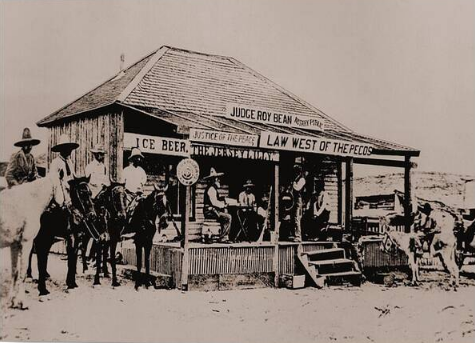
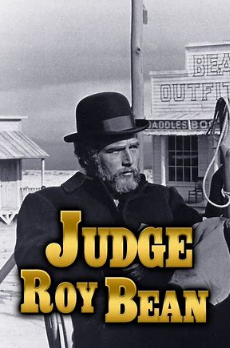
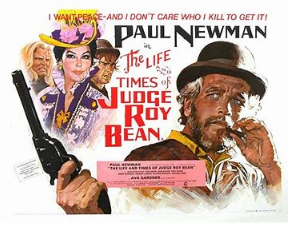
JUDGE ROY BEAN – Phantly Roy Bean, Jr. (Phantly?) was born around 1825 and passed away March 16th, 1903. The figure has been brought to the big and small screens multiple times over the decades, with Paul Newman’s The Life and Times of Judge Roy Bean as the most well-known attempt.
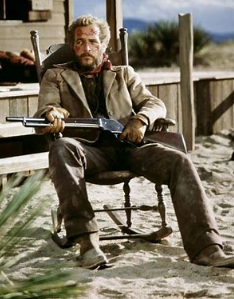 Well before this part-hero, part-villain became renowned as “The Only Law West of the Pecos” he was already experiencing an adventurous life. In 1841, at the age of 16, Bean hitched a ride on a flatboat from his dirt-poor Kentucky community to New Orleans, LA in search of work.
After assorted hell-raising, including a supposed stint as a riverboat gambler up and down the Mississippi, things got too dangerous for Roy in New Orleans so he fled further west. In San Antonio, TX he settled down with his brother Sam Bean for years, working in Sam’s trade of transporting goods to Santa Fe, NM and northern Mexico.
Sam served in the 1846-1848 war between the U.S. and Mexico, and after the American victory, Sam and Roy established a trading post in Chihuahua, Mexico. Having supposedly participated in riverboat duels, and in skirmishes with would-be bandits during his teamster years, Roy Bean was always ready with his firearms.
Before 1848 was over, a gunfight with a Mexican man who wanted to “kill a gringo” resulted in Roy shooting the man to death. This incident prompted Roy and Sam to skedaddle westward to Sonora, Mexico.
Roy soon traveled even further, and during the spring of 1849 he was in San Diego, CA where he stayed with another older brother, Joshua Bean. Joshua went on to be elected the first mayor of San Diego in 1850 and had a scandal-filled administration.
The even more tempestuous Roy continued hopping from job to job and spending his spare time drinking and romancing women. In February of 1852, Roy clashed with a man named John Collins over the same woman, prompting Collins to challenge Bean to a horse-mounted gunfight.
 On February 24th the men fought and wounded each other, but not mortally. They were arrested, tried and sentenced to jail. Already a well-known character, Roy had fans flocking to visit him behind bars.
One account holds that among gifts of food for the prisoner, one of Bean’s female admirers smuggled in knives for the maverick. Roy used those knives to dig himself free on April 17th, 1852 and took it on the run. In San Gabriel, CA, where Joshua Bean had relocated, Roy once again imposed on his big brother, who hired him as a bartender in his Headquarters Saloon.
On November 7th, 1852, Joshua was shot to death by four men in a fight over a woman, and Roy inherited the Headquarters Saloon. Unable to keep out of trouble himself, Roy had to flee town in 1853 after taking down a man in a knife fight.
Bean traveled around California and New Mexico for a time, and at some point in 1854 clashed with an army officer from Mexico over a young woman. (In the still unsettled conditions after the war, assorted Mexican officials still traipsed around on both sides of the border.)
Some of the wilder accounts maintain that the officer tried abducting the woman to force her into marriage. He and Roy Bean engaged in a gun fight, with Roy killing his rival. Six of the officer’s friends wanted revenge on Bean so they tracked him down and lynched him.
This entire affair stretches credulity, but it comes up in nearly every account of Roy Bean’s life. We are told that after watching Roy dangle on the noose, the sextet of Mexicans gave him up for dead and rode off. The woman, hiding nearby, is said to have cut Roy loose. This incident supposedly accounts for the rope burn scars that Bean bore on his neck for the rest of his life.
In 1855 Roy rejoined his brother Sam, who was now serving as the first sheriff of New Mexico’s Dona Ana County. The next verifiable(ish) information about Roy Bean came in 1861, when he and Sam were running a store and saloon in Pinos Altos, near iconic Silver City, NM. Roy had supposedly helped repel an Apache attack on Pinos Altos and had somehow obtained a cannon during the conflict. That cannon was now on prominent display outside the saloon.
 As the Civil War raged, Bean saw an opportunity to make some big money. Cashing out his half of the store and saloon, he returned to Texas in 1862 and smuggled cotton from San Antonio to Matamoros, Mexico where British ship captains paid him for the product in order to circumvent the Union Navy blockade of Texas.
On October 28th, 1866, Roy married Virginia Chavez, who bore him four children – daughters Laura & Zulema, and sons Roy Jr. and Sam. Throughout the rest of the 1860s and 1870s, Bean lived in San Antonio with his wife and children while pursuing various shady ventures.
He ran a bootleg firewood business by stealing lumber, lost a dairy business when he was caught watering down the milk he sold, and even resorted to rustling cattle. As the 1880s arrived, our man was running a saloon in the so-called “Beantown” section of San Antonio.
Beantown was generally a poor, crime-filled neighborhood and Roy supposedly engaged in a lot of illegal business from his saloon. San Antonio business leaders wanted Roy Bean gone and Beantown tamed, so they raised $900.00 to buy out Roy’s saloon, lock, stock and barrel.
By now separated from Virginia, Roy Bean took to following Hell on Wheels railroad settlements, and in the spring of 1882 he established a Pecos River saloon in a tent city called Vinegaroon, after the deadly scorpions of that name.
Some 8,000 railroad workers were associated with Vinegaroon, and with the nearest court being over 100 miles away, Texas Ranger T.L. Oglesby approached Roy about heading up a local law jurisdiction. Around July 25th, 1882 “Judge” Roy Bean presided over his first trial against a criminal named Joe Bell.
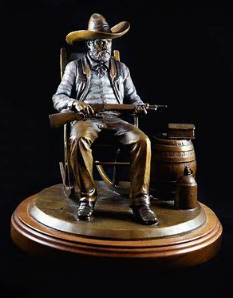 On August 2nd, Bean was appointed Justice of the Peace, which title held MUCH more power back then, especially in unsettled regions where law enforcement was scattered across great distances. His jurisdiction was technically Pecos County’s Precinct 6 but naturally Roy declared anywhere he pleased to be his jurisdiction.
The Judge’s saloon doubled as his courtroom, and the only authority he recognized was his copy of the Revised Statues of Texas for 1879. It seemed that for every decent decision he laid down, Judge Roy Bean issued many more that were tyrannical, invalid or self-serving power plays that protected his business interests. Ironically, he only sentenced two convicts to hang, and one of those escaped.
Bean kept moving his saloon and courtroom around the county as needed, and never had a jail constructed. Any prisoners were held at gunpoint inside the saloon or chained up to a sturdy tree near the doorway. Bean’s “sentences” were mostly in the form of fines of varying sizes.
With no other legal institutions in effect to challenge him in the badlands, the Judge thrived on his brand as “The Only Law West of the Pecos.” He ultimately settled down in Langtry, TX, which was named after George Langtry, however, Roy did name his Saloon/ Courtroom The Jersey Lilly after the British actress Lillie Langtry.
Contrary to many fictional depictions, Lillie did not visit the Judge’s establishment until after his death in 1903. The two did, however, maintain a correspondence after his initial invitation to her to come pay him a visit. Lillie even sent Roy two Colt 45 revolvers as gifts.
In 1886, the Judge was defeated when it was time to stand for reelection after his 1882 appointment. In 1887 a new jurisdiction was established in the area and Bean was again appointed as a Justice of the Peace.
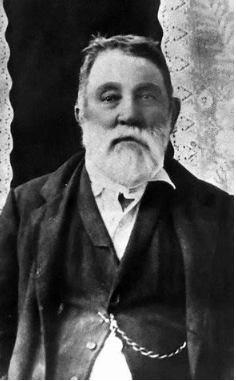 The scurrilous Roy was reelected a few times, but finally lost in 1896. As you could have guessed, that didn’t stop him from continuing to act as a Judge for all cases “north of the tracks.” Bean even refused to surrender his judge’s seal.
Eighteen ninety-six was also the year of the infamous World Championship Boxing Match that the Judge organized on an island in the Rio Grande River. (Boxing was still illegal in many jurisdictions at the time. See my look at gunfighter John Bull for more.) Bob Fitzsimmons defeated Peter Maher in Judge Roy Bean’s little footnote to boxing history.
Tales of Bean’s outrageous, unethical and mostly illegal decisions are legion. Some of them seem plausible, while others defy belief. It’s hard to know what to believe, but it IS certain that Judge Roy Bean died in his sleep on March 16th, 1903.
 Balladeer's Blog
Great posts as always. I’m not very familiar with heroes of the Wild West but I always find your posts to be entertaining to read. As a huge fan of the Western movie genre. this post brought to mind great Western movies that I admire. For instance, it reminded me of the movie “Power of the Dog”. A wonderful western drama, it told the story of a rancher keeping his sexuality hidden in plain sight. The main character bears striking similarities with Roy in your Frontierado story. One of the best movies of 2021 that didn’t get the recognition it deserved. Truly one of the best westerns of the past decade.
Here’s why it’s worth watching:
I appreciate it! I’m on my way to your review of The Power of the Dog!
Colorful doesn’t begin to describe this man. What a guy.
Yes, quite a character!
Beautiful story of Roy Bean . Very interesting life as hero or villen well shared.👍
Thank you very much!
And after all that, he dies in his bed! Great account.
Gwen.
Thank you very much! Yes, that’s as surprising with him as it was for Doc Holliday!