
Author John Dudley Ball, Jr. created the iconic African American detective Virgil Tibbs in his 1965 novel In the Heat of the Night. Sidney Poitier brought Virgil to life on the big screen in the classic film version in 1966. Poitier reprised the role in They Call Me Mister Tibbs (1970) and The Organization (1971).
 Balladeer’s Blog takes a look at the forgotten (or at least neglected) novels and short stories which John Dudley Ball wrote about his fictional detective. I am amazed that no one adapted the other Virgil Tibbs novels in the 70s, 80s or 90s. He is up there with other American detectives like Sam Spade, Nero Wolfe, Moses Wine and more.
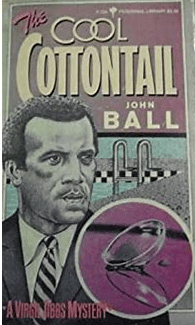
THE COOL COTTONTAIL (1966) – After winning the Edgar Allan Poe Award for Best First Novel for In the Heat of the Night, John Ball wrote this follow-up novel about Virgil Tibbs. If you’re only familiar with the big screen Tibbs let me point out that The Cool Cottontail is set in Pasadena, CA, where the literary Virgil Tibbs was a homicide detective. In movies Virgil worked in Philadelphia and San Francisco while the In the Heat of the Night tv series stranded him down south.
In this murder mystery Ball incorporated his real-life nudist lifestyle by having the victim’s body found in the pool at a nudist resort. A “cottontail” in nudist slang was a person who covered their genitals when sunbathing, leaving that area of their anatomy pale compared to the rest of their body.
The other nudists deny knowing the identity of the victim, and the corpse’s “clothing-free” state means our detective must first do a lot of work tracking down their name before he can even move on to solving the murder itself.
Obviously, this sequel story didn’t have the societal impact made by In the Heat of the Night, but as Virgil expertly investigated the murder he periodically had to deal with racism among some of the suspects. Some wry moments depict Tibbs dealing with certain public prejudice against the nudists themselves due to their lifestyle, but those moments aren’t presented as being equivalent to racial bias.
John Ball, a former cop himself, wrote Virgil as a consummate professional as he solves this case and deals with media attention plus ribbing from colleagues over the scandalous situation. Tibbs uses a combination of aggression and charm while extracting the secrets that his suspects are trying to keep.
The television series version of In the Heat of the Night sadly limited the popular perception of Virgil Tibbs by making him a permanent resident of Sparta, MS. The variety of situations that the homicide detective dealt with in Pasadena provided much more insight on how he was the total package as an investigator.
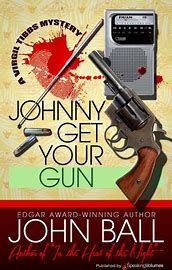 JOHNNY GET YOUR GUN (1969) – For some bizarre reason this novel was later retitled Death for a Playmate BUT it has nothing to do with Playboy magazine or its kind of Playmates. Given that the previous Virgil Tibbs murder mystery dealt with the nudist lifestyle I wanted to make that clear right up front.
Playmate in this context means a child’s playmate. Nine-year-old Johnny McGuire’s valued transistor radio gets smashed by a schoolyard bully, following which Johnny takes his father’s gun and sets out for revenge.
Our man Virgil Tibbs investigates the subsequent shooting incident and spearheads a citywide search for Johnny as the metropolis teeters on the edge of a race riot over the inflamed passions. Though today we are inundated with detective shows that become “issue of the week” dramas, please remember that this novel came out long before that type of cop story became a trope.
Tibbs must use every bit of his investigative brilliance and larger than life personality to prevent a city from burning while simultaneously finding a scared child on the run over his ill-considered actions. A chase around Disneyland makes for an interesting set piece as events unfold.
Children shooting at other children, gun control arguments and racial tensions egged on by the media. These elements may make Johnny Get Your Gun a novel to avoid right now for readers who might feel haunted by similarities to so much of what is in the news even now.
The ending has Virgil reveal a twist regarding the shooting incident, resolving the mystery. I liked that aspect of this novel but really disliked a hokey bit at the end featuring Gene Autry, the owner of the California Angels at the time. After a lot of grit and emotion we readers got an ABC Afterschool Special finale.
 FIVE PIECES OF JADE (1972) – Virgil Tibbs shines once again in a terrific, realistic police procedural long before that approach became the norm on television crime shows. Plus, John Ball’s dialogue is as good as ever.
Wang Fu-sen, a high-profile dealer in jade carvings, is found murdered. Homicide detective Virgil Tibbs is assigned to the case and plunges into the multiple mysteries involved.
As our hero strips away layer after layer of this unusual case he is forced to expand the investigation to cover human trafficking, the narcotics trade and Communist China’s possible role. A beautiful lady that Virgil falls for is also one of the murder suspects in timeless hardboiled tradition.
Chinese cultural bigotry toward people of mixed race is also addressed in this lesser but still entertaining novel. You know the formula of a murder mystery like this. Not much I can add about the intricate storyline since I’m avoiding spoilers. However, the way that these Virgil Tibbs stories are so old the period piece appeal adds to the entertainment.
 ONE FOR VIRGIL TIBBS (1976) – The first of the short stories featuring John Ball’s fictional cop, this was first published in Ellery Queen’s Mystery Magazine in February, 1976. When a skull is found on a busy construction site, the resulting murder investigation is one for Pasadena’s ranking homicide detective – our man Virgil Tibbs.
A later episode of the television series Quincy once did a similar story but with a different bone rather than a skull.
No way to elaborate more about One for Virgil Tibbs without spoilers. It’s short and sweet, but sadly that also means readers don’t get to spend as much time as we usually do with the turbo-charged personality of our detective.
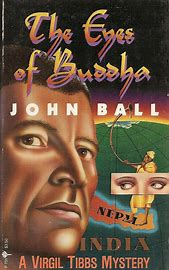 THE EYES OF BUDDHA (1976) – This fifth Virgil Tibbs novel deals with how the detective’s long-ago case in which he investigated a murder in Sparta, MS has since become a nationwide “True Crime” sensation. We readers are told that the resulting movie starring Sidney Poitier exists in Virgil Tibbs’ “real” life.
Some Tibbs fans express annoyance over this element of these later stories but I’m fine with it. To me it’s no different than the way Arthur Conan Doyle depicted Sherlock Holmes becoming a household name in Victorian England thanks to his friend Watson’s writings about the cases he solved.
However, even I roll my eyes a little over the way John Ball started putting in more and more references to other fictional detectives being “real” and existing in the same world inhabited by Virgil Tibbs.
At any rate, The Eyes of Buddha starts out with the discovery of a dead body which resembles a wealthy heiress who disappeared over a year earlier. Virgil efficiently proves that the remains are not those of the missing heiress, but that young lady’s rich and powerful parents pull strings to get the now-famous Tibbs put on special assignment to try locating their missing daughter.
Our hero’s investigation leads him overseas as far as Katmandu and he turns up evidence linking the heiress’ disappearance to the murder of her lookalike back in Pasadena.
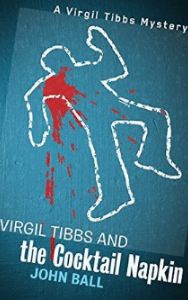 VIRGIL TIBBS AND THE COCKTAIL NAPKIN (1977) – Another Virgil Tibbs short story, this one first saw print in Ellery Queen’s Mystery Magazine for April of 1977. Fans of Sherlock Holmes – or of modern-day Crime Scene Investigation science – would likely enjoy the way detective Virgil Tibbs uses the sole clue of a cocktail napkin to figuratively “reverse-engineer” the murder he is currently investigating.
Once again, the brevity prevents us from getting as much Tibbs as we might want, but such is the short story format. It also means I can’t write too much without spoiling story developments.
VIRGIL TIBBS AND THE FALLEN BODY (1978) – This third short story featuring Virgil was published in Ellery Queen’s Mystery Magazine for September of 1978.
Virgil Tibbs and the Fallen Body is my least favorite Tibbs story. Our iconic detective remains firmly in the background during this murder investigation. He only shines one time – when he draws attention to a vital clue that his less-observant colleagues missed.
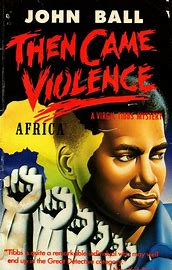 THEN CAME VIOLENCE (1980) – Virgil Tibbs is back in the sixth novel devoted to his detective career.
Our hero comes back from his swinging vacation to find his bachelor pad has been stripped of every piece of furniture and his other belongings. NOTE: Yes, in the novels and short stories, Virgil was unmarried.
Tibbs’ police department superior has him covertly visit an alternate address where he finds all of his missing possessions have been relocated. He also meets a woman who identifies herself as Mrs. Virgil Tibbs.
It turns out that our hero’s fame has once again gotten him personally requested, in this case by the U.S. government. The fake Mrs. Tibbs is really the wife of an African President whose regime is on the brink of collapsing. She and her husband are in the middle of being given political asylum in America if the worst happens. So until her husband can be exfiltrated if necessary, Virgil and the foreign First Lady – real name Miriam Motamboru – will be living together while he guards her.
Hey, isn’t this like the plot of the blaxploitation film The Guy from Harlem (1977)? Anyway, while serving as Mrs. Motamboru’s bodyguard Virgil also gets caught up in a case involving a holdup followed by the vigilante slaying of one of the holdup men.
When the undercover First Lady gets nabbed, it’s up to our hero to save her and tie in the holdup and execution-style murder. Then Came Violence flirted with Robert Ludlum territory while I prefer the Tibbs novels that were more grounded in an Ed McBain or Joseph Wambaugh kind of way.
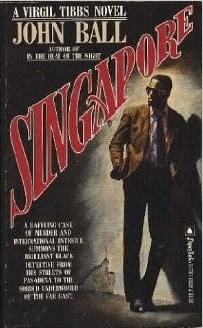 SINGAPORE (1986) – Madame Motamboru returns in this final Virgil Tibbs novel. Her husband is dead and she has been trying to run the country (Bakara) while keeping that African nation in the U.S. camp as the Cold War continues.
Internal and external enemies caused Miriam to wind up in Singapore, where she has been framed for a man’s murder. The U.S. government is sympathetic to her plight, but the Soviet Union threatens to escalate the situation if America grants her asylum.
Madame Motamboru insists that her old acquaintance Virgil Tibbs be drafted to go to Singapore and prove her innocence in the murder case. The government agrees and our hero sets about solving that crime as well as clearing up a case involving multiple slayings of children in Singapore.
LONE SPOILER AHEAD
Virgil clears Miriam, ends the series of child murders and as the story comes to a close, he and Miriam make plans to get married.
Despite many claims that there are only three Virgil Tibbs short stories, there is a fourth one titled Good Evening Mr. Tibbs (1987). I’m in the process of obtaining a copy and will review that item ASAP. NOTE: I have reviewed it HERE.
FOR MY REVIEW OF DASHIELL HAMMETT’S FINAL NOVEL THE THIN MAN CLICK HERE.
 Balladeer's Blog
I loved In the heat of the night’ but have never seen any of the books following. They are now on my list of books to get, so thanks for that.
Gwen.
Glad to do it! Thank you for such a nice comment!
Wonderful post!
Thank you very much!
Those all sound good. I’d forgotten about Virgil Tibbs.
Yes, I wish some of them had been adapted as movies. Not even the other two Poitier films as Virgil came from the books, they were original screenplays.
Great list of Ball’s work, and nice to see it featured 🙂
Thank you very much! I appreciate it!
Great review. I can see why you have called it a forgotten book because I’ve never heard of it. That being said, the concept of a black detective appears intriguing to me. Ever since the time of Agatha Christie, most books have often told detective tales from a white point-of-view. The concept behind the book reminds me a lot of Spike Lee’s Oscar-winning film “BlackKklansman”. It tells the story of a black undercover cop that seeks to investigate the Klu Klux Klan. It’s a true story that has to be seen to be believed. Here’s why I loved it:
Thank you! So many of the Virgil Tibbs mysteries have been overlooked.
Great posts as always. I have not heard of Virgil Tibbs before but he definitely appears to be a fascinating detective. He reminds me a lot of iconic detectives in movies that I have seen. For instance, he brought to mind Sherlock Holmes. Holmes is an iconic literary character that has been portrayed in countless great movies. For instance, I admired Henry Cavill’s portrayal of the iconic sleuth in “Enola Holmes”. He shared many of the same qualities with Virgil Tibbs such as a love for mysteries, solving murder and adventure. The only difference between the two characters is the skin colour.
Here’s why “Enola Holmes” is worth seeing on Netflix: