
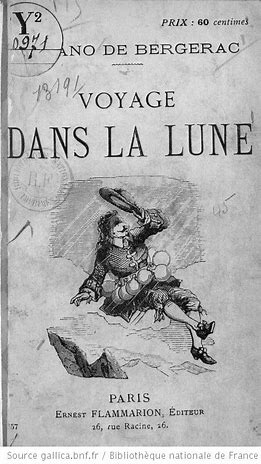
 A VOYAGE TO THE MOON (1657) – Written by Cyrano de Bergerac. Yes, the one and only Cyrano de Bergerac, noted for his prominent proboscis and for Rostand’s play depicting his romance with Roxanne, at first acting on behalf of his friend. Some people still mistakenly believe Cyrano was a fictional character.
If he seems an unlikely man to dabble in science fiction consider this brilliant excerpt from de Bergerac’s writings: ” I think the planets are worlds revolving around the sun and that the fixed stars are also suns that have planets revolving around them. We can’t see those worlds from here because they are so small and because the light they reflect cannot reach us. How can one honestly think that such spacious globes are only large, deserted fields and that our world was made to lord it over all of them …?”
 Cyrano’s fictional space traveler was named Dyrcona and was the first to use multi-stage rockets to reach his destination. Dyrcona’s rocket design was based on firecrackers of the time period. The lunar inhabitants wore no clothing, had four legs and spoke in song. Their technology included transparent globes that captured solar rays for illumination, talking book-machines (early radio) and ray-guns that not only killed game but simultaneously cooked it.
Dyrcona discovered that the Garden of Eden was also on the moon. The moon people expected Dyrcona to prove that he was really from the Earth because the moon’s inhabitants were convinced that no intelligent life resided there.
 A VOYAGE TO THE SUN (1659) – Written by Cyrano de Bergerac. Yes, the world can also credit Cyrano with the first-ever science fiction sequel! Following the adventures he experienced on the moon Dyrcona planned his logical next journey – to the sun itself.
Dyrcona’s means of transport were far less impressive scientifically this time around however. Cyrano misconstrued the way vacuums work and depicted his hero traveling in a large box designed of multiple layers of hollow crystal. When the sun’s heat exhausted the air in the crystal it formed a vacuum and drew the box toward the sun. Considering how forward-thinking de Bergerac was with the multi-stage rocket of his previous novel this is a very disappointing step backward.
The sun was depicted as an inhabited world just like the Earth and the moon and its climate featured burning snowflakes that fell from the sky like ashes.
Not only that, but the sun was inhabited by intelligent birds who could speak and use artificial eyes for night vision among other accomplishments and who put Dyrcona on trial for the crime of being a human being. Any fan of Star Trek can’t help but picture James T Kirk facing a similar situation.
FOR MORE ANCIENT SCIENCE FICTION CLICK HERE.
 Balladeer's Blog
Man’s imagination is amazing.
I agree!
Thank you. When one’s education halts, one should surely pull the cloak of earth, all and only to which he is immortally entitled, around his shoulders, sigh his last, and leave life to the living.
Whoa! Pretty dark, dude, not your usual self!
I believe the hollow planet concept was popular back then, including Jules Verne.
You are absolutely right.
AH-! 😀
😀
Pingback: BALLADEERS BLOG – El Noticiero de Alvarez Galloso
Logged, thanks!
👌👌
Thank you very much!
☺️
😀
☺️
😀 😀
😝😝
Great book review. I mentioned before that I don’t find time to read books nowadays, but “A Voyage to the Moon” definitely sounds fascinating to me. I’ve always enjoyed science fiction movies set in space, and this definitely falls into that category. The plot description of the book reminds me a lot of Alfonso Cauron’s Oscar-winning film “Gravity”. A magnificent science fiction epic which captured the dangers of travelling in space. If you enjoyed “A Voyage to the Moon”, you will probably love this movie as well. Here’s why it’s well worth a watch:
“Gravity” (2013) – Movie Review – The Film Buff (huilahimovie.reviews)
Thank you! And yes, I’ve heard good things about Gravity.