
Korea
As always here at Balladeer’s Blog I like to examine topics that I feel don’t get enough attention. The gods and goddesses of Korea are the topic of this latest article on an underappreciated pantheon of deities. Readers interested in myths from around the world may want to also check out my pages on Navajo, Vietnamese and Bunyoro myths. In addition I have done articles on Shinto mythology – https://glitternight.com/shinto-myth/
Plus a look at Hawaiian mythology – https://glitternight.com/2011/02/20/the-top-eleven-deities-in-hawaiian-mythology/
https://glitternight.com/2011/04/10/the-eleven-most-neglected-deities-in-teutono-norse-mythology/
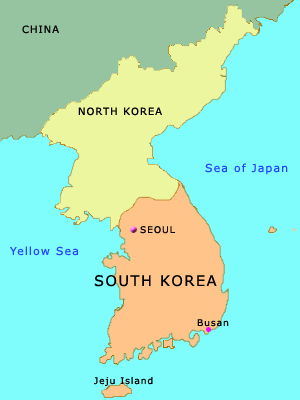
11. IGONG – Also called Hallakkungi, this god tended the Flower Garden Of Life And Death. This garden contained flowers that were really the souls of each person on Earth and Igong oversaw the length and quality of each life. After ending those lives by plucking their corresponding flowers from the garden Igong also decided on the soul’s merits for rebirth. This god was worshipped only on Jeju Island, the huge island off the southern coast of Korea. Jeju is also spelled Cheju because our alphabet has no true equivalent of that consonant sound from the Korean language.
10. TANGUN – The founder- god of the ancient Choson kingdom supposedly in 2333 B.C. Tangun was the son of Hwanung, the god of the laws who descended from the heavens to teach humanity how to live and adapt to the world when it was young. Tangun established an ancient city near Pyeongyang, which the demented Kim Jong IL of North Korea claimed to have unearthed in recent years but for some reason (HA!) refused to allow outside authorities in to confirm the claim.
Tangun ruled as a combination king and high priest and is still worshipped today by many modern Koreans who follow Cheondogyo, “the religion of the heavenly way.” We are told Tangun ruled for 1,500 years, then became the guardian god of Mount Taebaek.
9. YUHWA – The goddess of willow trees, this daughter of the river- god Habaek was desired by the sun god Haemosu. The sun god trapped her by causing a copper palace to grow from some lines he drew on the ground. Yuhwa and her sisters, intrigued by the sudden appearance of the magnificent structure, ventured in and were lavishly entertained by Haemosu and his attendants.
At a sign from the sun god the attendants made to bolt the doors so they could trap the three goddesses within. Yuhwa’s sisters were swift enough to escape, but Yuhwa was captured by Haemosu and taken off to be his wife. Eventually she fled Haemosu and, while hiding with King Keumwa of Puyeo she gave birth to Haemosu’s son Jumong.
8. KIMSURO – The god sent down from the heavens to rule the Kaya region of Korea in approximately 43 C.E. Nine elders ruled the Kaya region – one from each of the main city- states, but the lack of a central authority prompted them to pray to the heavenly king of the gods Hwanin for a strong ruler to unite them. Hwanin’s voice rang out from the heavens, drawing a crowd of hundreds to Kuji Mountain, where he instructed them to sing the Kujiga.
After the song was sung, Hwanin lowered a golden chest from the sky, a chest containing six large golden eggs. From these eggs hatched the god Kimsuro and five of his subordinate aristocrats, all of whom grew to be nine feet tall in a matter of days. Kimsuro united the nine city-states into the kingdom of Kaya, defeated the god Talhae (future founder of Shilla) in a metamorphosis duel and refused to get married until the gods sent a wife, Hwangok ,to him from India.
7. HABAEK – The god of the Yalu River, which borders what is now North Korea and China. As such he had special significance as the watchman over the northern frontier. Habaek’s daughter Yuhwa was snatched away by the sun god Haemosu and made his bride.
Habaek complained to Hwanin, the Heavenly King of the gods, who ordered Haemosu to meet with his irate father-in- law. Haemosu defeated the river god in a metamorphosis duel, besting him in the forms of animals of the sea, land and air, but then benevolently acquiesced to Habaek’s demand for a formal wedding ceremony. Following that ceremony the still- reluctant bride fled Haemosu, ultimately hiding with King Keumwa of Puyeo.
6. KOENEGITTO – The war god of Jeju Island, home of a shrine that bears his name. Koenegitto had a bronze gong which, when struck once, could conjure up an army of a million soldiers out of the air. When struck twice the army would disappear. Koenegitto was the son of the shrine god Sochonguk through the mortal woman Paek Chunim. When Koenegitto turned three he was so uncontrollable that Sochonguk locked him in a chest and tossed the chest into the sea.
Koenigitto escaped the chest, married the youngest daughter of the dragon god of the sea but was asked to leave the sea kingdom when his enormous appetite was emptying the dragon god’s larder. He and his wife went to Chonja on the Korean mainland, where Koenegitto became a hero by driving away an invading army (led by multi- headed generals) from the north. The bronze- armored demigod then returned triumphantly to Jeju Island for revenge on his parents for tossing him into the sea. He scared them both to death, then transformed his father into a mountain ridge and his mother into a shrine.
5. HAEMOSU – The Korean sun god, usually depicted wearing a headdress of crow feathers from the gigantic crow he killed when it stole the sun and he had to retrieve it (crows have connections with the sun in Chinese myths, too and in Vietnamese mythology some versions claim that the sun goddess’ palanquin is adorned with crow images instead of rooster images). For his chief weapon Haemosu wielded a solar sword that shone as brightly as the sun.
Each dawn as the sun, his home, made its way across the sky he would leave it to take its course while he flew down to the Earth on his chariot. That chariot, Oryonggeo, was drawn by five flying dragons and traveled faster than the wind. The sun god’s retinue, meanwhile, accompanied him riding giant white swans that floated on multi- colored, music-producing clouds.
Haemosu and his court would land at Puyeo, the ancient capital of what would eventually become the combined Three Kingdoms of Korea. There the sun god would attend to the affairs of mortals all day, returning to his solar home at sunset. Haemosu desired the goddess Yuhwa, who bore his son Jumong.
4. KOEULLA, PUEULLA AND YANGEULLA – These three progenitor gods of the Three Clans of Jeju Island are always mentioned in unison. They are the sons of Halmang, the goddess of Jeju Island, and emerged from her womb, the ground, at a hole named Mohung near Mount Chu. This spot, called the Hollow of the Three Clans, is a landmark in modern day Jeju City. The three brothers roamed the island hunting game, eating the meat and making clothes from the skins.
One day three brides arrived for them, sent with respects from the ruler of Pyeongyang on the Korean mainland. The brides brought with them calves, colts and the Five Grains – barley, rice, soybean, millet and foxtail millet. In Korean mythology these five grains symbolize all of agriculture.
Each of the three gods took a bride for himself and established settlements, with their countless offspring forming the mythical Three Clans from which all the people of Jeju Island supposedly descended. Each clan claims their progenitor was the first-born of the three gods.
3. HWANUNG – The god of the laws and father of the demigod Tangun, one of the important founder- heroes of northern Korean lore. Hwanung told his father, Hwanin, that he desired to live among the people who worshipped them.
Hwanin designated Mount Taebaek near modern Pyeongyang for his son to establish himself. Hwanung descended there with Aryongjong, the goddess of rainfall and Yondung, the wind goddess. He gathered three thousand initial followers around him and established the Divine City, from where his rule spread.
Hwanung instituted three hundred sixty laws governing not just the affairs of humanity, like government, agriculture, morality, punishments and society but also governing natural laws on the young world. These laws pertained to lifespans, illnesses, science, etc, similar to certain concepts in Sumerian myth.
When both a female bear and a female tiger prayed to Hwanung to be made human, only the bear passed Hwanung’s test and became his bride, the mother of Tangun and through him many descending generations of Koreans. The mythical significance is that it was the patience of the bear, not the violence of the tiger, that became part of the Korean character and enabled them to endure and survive repeated invasions by Japan and China.
2. HALMANG – The goddess of Jeju Island, often depicted embodying the island the way Earth goddesses are often depicted embodying the entire planet. She could also assume giantess form and roam the island at will and much of her mythic cycle deals with her activities in that mobile form. Her diahhrea after having eaten millet porridge resulted in 360 of the hills and mountains of Jeju Island.
Halmang also arranged all the valleys and rivers of the island to her liking, too. Her urine caused the channel between Jeju Island and mainland Korea, or the channel between Jeju Island and nearby Udo Island, depending on the version.
When the people of Jeju Island wanted the goddess to cease walking around naked in her giantess form she told them that if they could make clothing large enough to fit her she would build them a bridge to the mainland. The people exhausted all of the material on the island but still the clothes they made were not large enough to cover Halmang, so she stopped her own efforts, leaving the bridge half-finished. (This is similar to many Philippine myths about giant gods or goddesses partially completing bridges between islands)
Another myth involves her out-doing her husband, the god Halubang, at fishing by lying in the ocean and swallowing all the fish into her vagina. (This is similar to one of the Vietnamese myths about Giat Hai outdoing Khong Lo) With that husband, the god that the large, ancient stone phalluses on Jeju Island are dedicated to, Halmang spawned Koeulla, Puella and Yangeulla, the progenitor gods of The Three Clans of Jeju Island.
 1. JUMONG – The god who founded the ancient kingdom of Koguryeo, from which the name Korea was ultimately derived. While Jumong’s mother, the goddess Yuhwa, was hiding with King Keumwa she gave birth to an egg which contained the offspring of the sun god Haemosu. Fearful over the strange birth, King Keumwa exposed the egg to the horses of his stable, but none of them would trample it. He left it in the forest, but none of the animals would harm it. He tried to prevent Yuhwa from warming the egg, but Haemosu made a shaft of sunlight keep the egg warm, even on cloudy days.
Keumwa gave in and let Yuhwa care for the egg, from which Jumong eventually burst forth, like many other gods in Korean mythology. (See Talhae and Pakhyeokkeose, also born of eggs; Kimsuro, born of a golden egg found in a golden chest; and Kimalji, born from a golden chest alone, just to be different)
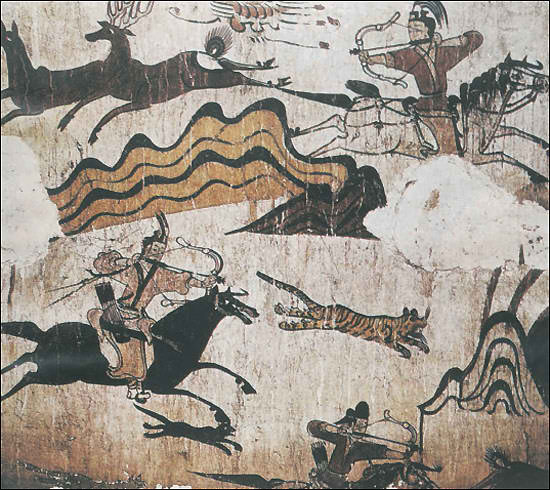
Jumong could speak after just one month and grew to adulthood very quickly. He had supernatural skill as an archer and was said to be able to shoot even tiny objects like fleas from a great distance. He always outdid King Keumwa’s sons, who grew to resent him, which conflict ultimately led to Jumong heading south to establish his own kingdom, with his mother’s blessing (in some versions she also gives him the Five Grains to take with him).
Keumwa’s troops pursued him to the Kaesa River, where there was no ferry. Not wishing to have to strike down the army of the man who had been kind to his mother, Jumong instead shot an arrow into the river and in the name of his godly heritage as the son of Haemosu and Yuhwa, commanded all the fish and turtles in the water to form a bridge for him to cross. They obeyed and after he successfully crossed, the animals gave way, letting the pursuing soldiers fall into the river.
Balladeer’s Blog
Next Jumong overthrew King Songyang by obtaining a sacred drum and bugle, defeating him at an archery contest and by calling on the rain goddess Aryongjong to cause a flood that washed away Songyang’s capital city (which certainly seems more effective than drums, bugles and beating the guy at archery).
The common people of the city were saved from the flood by Jumong, riding a horse-sized duck. He then used his godly power to cause a new city to form out of mist on the spot in just seven days, and this became the capital of his new kingdom called Koguryeo. His own son Yuri went on to become a great king, too. Jumong is sometimes spelled Chumong for the same reason Jeju Island is sometimes spelled Cheju Island.
© Edward Wozniak and Balladeer’s Blog, 2011. Unauthorized use and/or duplication of this material without express and written permission from this blog’s author and/or owner is strictly prohibited. Excerpts and links may be used, provided that full and clear credit is given to Edward Wozniak and Balladeer’s Blog with appropriate and specific direction to the original content.
 Balladeer's Blog
I really enjoyed reading this! Especially the paragraph on Hwanung.
I listed you as a blog to check out for anyone who stumbles onto mine.
I hope you don’t mind haha.
Well, thank you very much! That was very nice of you! Always glad to have visitors and I’ll be adding a link to your blog on mine as well!
Rilly enjoy ur myth posts and the unusual gods u find
Thanks! That is very nice of you !
OMG it’s like your the Homer of all these unsung myths. Keep them coming please.
Well, thank you! I’ve got a lot more coming!
Well, I’m here teaching the good ol’ English language. I’m here until at least April sometime. You should come and visit us here sometime! Jeju is a nice and relaxing place.
Jeju Island sounds great and I’d love to see the Hollow of the Clans mentioned in my article!
woooow, never thought that korean myth is very colorful and interesting as well!
thanks for the post!
No problem!Thank you for the comment. Very sorry about the delay in answering. I don’t know how I missed this comment.
It’s really nice how every place in the world must have had gods and goddesses like this.
I agree!!!
Pingback: Philosophy Courses | Philosophy Degree Resource Guide
Thanks for the pingback!
hi i’m plannin a trip to seoul in May 09 and came upon your blog of this place where i will be punittg up in my 10 day stay :p any places you recommend that is a MUST see in that area? thanks!krilymon@gmail.com
I’m afraid I’m not much on travel destinations but thanks for stopping by!
The rain goddess is my favorite! u should do 1 on just her!
I may do taht in the near future!
Awesome post dude! That sun god is a real bad ass!
Thanks and thanks for the comment!
Yuhwa knew what she was doing! Get away from that sun god quick!
Ha! I’ll say she did!
Koguryeo to Korea! Cool! I can see the link!
Thanks! I know what you mean!
Really enjoyable! Love the naked giant goddess! u go girllll!
Thanks! She certainly is unique!
Kewl as shite buddy! Sounds like the sun god was the cocksman of the group.
Sounds like it!!!
Really kewl! Too much testosterone compared to ur other lists but that can’t be helped with some I guess.
Thanks!! ! !
Mountains made out of diarea? Gross!
Ha! I’ll say!
Jumong kicks butt and needs a major motion picture.
I agree. In the meantime he has a live action tv show in Korea as part of the Korean Wave, sort of a cultural renaissance reviving a great deal of Korea’s past. The tv show just features him as a human hero with no special effects for budgetary reasons.
I would have loved a full entry on the rain goddess.
Maybe in the near future!
Got to say I also love the goddess of Jeju Island. She’s my kind of lady!
Wow! I hope that doesn’t mean you have mountain-sized bouts of diahrrea!
Keep it up please! I am rally enjoying lerning about more than the usual Greek gods
I plan to! Thanks !
Pingback: My Homepage
‘preciate the trackback!
The rain goddess Aryongjong sounds interesting.
I agree! She does!
That war god story was very odd. Igong was my favorite.
Thank you for letting me know!
Pingback: Homepage
…………..thanks for the trackback
thanks for all those informations , from long ago i know only aboutbut HABAEK , the River god (from korean comic manhwa bride of the water god) but korean have so many gods , so interesting , i love mythology andanything have to do with deitys
(sorry for my bad english )
Thank you very much! I think South Korea has a tv show called Jumong, but they avoid anything supernatural to save on their special effects budget and just have him as a rebel fighting a Chinese invasion.
If you like deities I’ve got a lot of articles on them here.
Great reading! You really are the brat prince of blogging with these mythology posts.
Thanks … I guess.
Igong is really cool!
…..I agree …
Pingback: mold on wall
Thank you for this trackback!
Korean gods are so cool! Awesome the way u bring up these forgotten pantheons!
,.,.,.,Thank you!
U da man! Korean myths rock!
Thank you^^^
Aryongjong sounds very interesting.
She sure is!
Igong is really cool.
I agree with that ^^^^^^^^^
Pingback: Our site
App reciate the trackback!
im looking for legend its a bout a goddess and her sisters that come down to earth every lunar moon and a wood cutter was told when and wher to find them he steals the dress so she cant go back with her sisters
Hello! Sorry about the delay but all the basketball this month has me way behind on answering comments. Thanks for asking this question!
This story has variations in Korean, Vietnamese, Philippine, Malagassy and other mythological pantheons. Sometimes the woman is a goddess, sometimes a star. She and her sisters come down to the Earth regularly to remove their “wings” or “star-clothes” or “gowns” and take a swim.
A man who is sometimes a hunter and sometimes a woodcutter, watches from hiding, steals one of the girl’s oufits so she cannot fly back to the heavens and then marries her. The followup often involves them eventually separating when he gives back her gown/wings/ star outfit. They argue over the division of their children, usually an odd number like three or five or one, with the gruesome result that to make the division of the children even one of the kids has to be torn in two.
In some variations the divided child is provided with artificial body parts (wood, stone or otherwise) to replace the missing ones and becomes a hero.
and yes legend is korean
If you are a teacher, I recommand you to change “Sea of Japan” to “East sea”. Several acient map shows it is “East sea” not “Sea of Japan”.
Thanks! I’ll do that!
Fantastic! I love myths and never knew about these gods!
Glad to share the word!
Pingback: Babs
I’m happy to spread the word!
Excellent look at Asian myths!
I appreciate that!
Aryongjong is my favorite!
Thanks for weighing in!
Pingback: Benji
It makes him a regular mortal and has him fighting the Chinese, so it changes to story quite a bit.
Loved the slam of Kim Jong il
ha! Thanks!
Pingback: Chao
Thanks!
Hwanin deserved more!
You may have a point!
As a korean person who grew up in north america, i always found it a bit sad that i couldnt find traditional korean mythos (mom’s devout catholic and dad is atheist). I sincerely thank you for helping me find some form of my roots in the form of beautiful legends 🙂
No problem at all! Thank you for such a kind sentiment!
Pingback: Oakley
I’ll have more in the near future!
We in south korea thank you!
No problem at all!
Pingback: Black Oak
Thanks! Is he still coming to the rescue?
Reddish Brown and Blueish Green
Jermaine Paul kicked off the night with a powerful performance of “I Believe I Can Fly,” accompanied by a gospel choir and violinists.
This is really awesome 🙂 I am a 1/4 Korean but knew very little about Korean mythology….now I know more and feel more in touch with my roots 🙂 THANK YOU!
Thank you very much for the nice comment! I will post another look at a different Korean deity in the next few days just for you!
Thanks again!
Oooh, thanks a lot, I am honored 🙂 Looking forward a lot!
Pingback: KOREAN DEITY: TALHAE | Balladeer's Blog
Pingback: International Culture
Thanks for the pingback
Pingback: kamukta
Thanks
Pingback: The Godhead
Thanks
Pingback: Asian Myths
Thanks
Pingback: Asian Myths
Thanks
Pingback: horoscoop-vandaag.com
Thanks
Pingback: https://glitternight.com/2011/03/24/the-top-11-deities-in-korean-mythology/ | jkmhoffman
r …
can you provide pictures for each god and goddesses? thanks
I’ll see what I can do.
Pingback: accessorily almira astrologistic
thanks
How dare a white male write about Korean gods and goddesses! I demand that you stop this cultural exploitation right now!
Try and stop me you racist whacko! Now run along to your psychiatrist.
Pingback: THE TOP PANTHEONS COVERED HERE AT BALLADEER’S BLOG | Balladeer's Blog
My favorite is Koenigitto!
I understand!
Hi, I do believe your blog could be having web browser compatibility problems. When I look at your website in Safari, it looks fine but when opening in I.E., it’s got some overlapping issues. I simply wanted to provide you with a quick heads up! Aside from that, excellent website.
Thank you
I got what you mean , thanks for putting up.Woh I am delighted to find this website through google. “Delay is preferable to error.” by Thomas Jefferson.
Hello! This is my first visit to your blog! We
are a group of volunteers and starting a new initiative in a community in the same niche.
Your blog provided us beneficial information to work on. You have done
a outstanding job!
Pingback: The Jeffrey Fowle flow DEMO of IRON MAN and his “Journey to the Center of Earth’
Pingback: Jeffrey Fowle database explains Nature’s OPTICAL MILITARY system | Nature's Symbol Machine and Language WAR codes and equations
Enjoy
Pingback: [ Mythologie ] Divinités Féminines Coréennes. | ☤ Sanctuarium Divinae Lucis ☥
Enjoy
Agree absolutely. None of the multicultural lefties can ever understand what makes freedom essential.
I really Love your post. Its so true … Everithing you say it real…
Hi!, first time reader here. I really liked your postpage. I found it to be really helpful. Keep up the awesome work! I’ll be sure to share with my followers
Residential proxies for North Chicago, Illinois: https://goo.gl/pCgAfG
do you live in Canada or the States? Do you live in New England, MidAtlantic, Midwest, Mountain, Southwest, Pacific, South or Great Plains if you live in the States. If you live in Canada which of the southern Provinces..
Α viewer recentⅼʏ asked thhe Savings Mommy ɦow
to bе alաays ɑ mystety shopper, аnd іn tɦе coolumn օff thіѕ
month, she teⅼls hoᴡ tо үoս.
Definitely a well-written post.
Pingback: URL
I needed to thank you for this great read!! I absolutely enjoyed every little bit of it. I¡¯ve got you book-marked to look at new things you post¡
Pingback: Information FABRIC data strings (Group 26) – the Nikola Tesla EARTH geography sin waves of Nevada and the Negev Desert …. and the sin wave FUNCTION wars in the Sinai Peninsula – Herb Zinser's information FABRIC data
Enjoy
Pingback: information FABRIC data strings (Group 26) – the Solar System photosynthesis battles at Sun Prairie, Northern Illinois, and Virginia TECH explained by Sunil Tripathi, Nilsestuen, and the Korean SUN GOD – Herb Zinser's Science Reports
Enjoy
Simply desire to say your article is as astounding. The clearness in your post is just cool and i can assume you’re an expert on this subject. Fine with your permission allow me to grab your RSS feed to keep up to date with forthcoming post. Thanks a million and please keep up the rewarding work.|
DONALD TRUMP FOR PRESIDENT!
LIke your post. Can we exchange links?
Sure!
Its like you read my mind! You seem to know so much
about this, like you wrote the book in it or something.
I think that you could do with a few pics to drive the message home
a bit, but instead of that, this is fantastic blog.
A fantastic read. I will definitely be back.
I´ve just found your blog and would like to thank you so much for this posting!
No problem at all~ Thanks for commenting
Thank YOU, actually. Works like yours are crucial to make reliable info more accessible over the web for anyone who is seriously interested in learning more, and not just those who are studying at the universities.
I´d just like to suggest that you add some bibliography( i.e. of the texts you´ve used as sources). This way your posting gets even more substantiation.
Thanks again! I’ll do that, I thought I had already. Thanks 4 catching that. I’ll add those soon.
Pingback: TOP ELEVEN DEITIES IN AZTEC MYTHS | Balladeer's Blog
logged
I couldn’t agree with you more. I have been advocating that social media is part of the PR realm since it began. I also think it’s very important that a professional PR person write a company’s blog (or at least review it). Companies put a lot on the line when they have a blog and it should be treated the same as a press release or similar important messages.
http://allin1panel.com/blog/everybody-know-social-media-marketing/
That war god on the island should be made into a movie.
I agree! Or at least animation!
Aryong Jong is my favorite!
That is good to hear!
You sure about that story about the sun god?
Yes I am.
This is the best blog I ever read!
Thanks!
Pingback: SUN GODS FROM AROUND THE WORLD | Balladeer's Blog
Noted.
That is the very best look at Korean gods anyplace.
Thanks!
Hi There! We are looking for some people that might be interested in from working their home on a part-time basis. If you want to earn $100 a day, and you don’t mind writing some short opinions up, this might be perfect opportunity for you! Simply click the link here NOW!
You should have done more Korean goddesses.
Maybe so!
This information is magnificent. Yuhwa was my favorite.
Thanks and thank you for commenting, too!
Korean gods? Heavy.
Thank you for this forgotten Korean myths and for having your President Trump be a brave man, unlike Obama.
No problem on both counts!
“I am just starting to learn about all of this so ive been doing some searching. Thanks!”
No problem.
Pingback: AZTEC DEITY TEZCATLIPOCA | Balladeer's Blog
Pingback: N is for Nexus | Writing Wings
Logged.
I loved the shot at the Kim dictatorship.
Thanks!
Im obliged for the blog post.Really looking forward to read more of your mythology entries. Great.
Thanks.
A big thank you for your blog article.Thanks Again. Really Cool.
Reblogged this on COLOMBIANSØUL.
Thank you!
Nice breakdown of these gods.
Thanks.
This is very fascinating, You are a very professional blogger. I’ve joined your feed and look forward to looking for extra of your fantastic post. Also, I’ve shared your web site in my social networks!
Thanks.
Who knew Korean myths were so much fun!
I understand how you feel.
Korean gods are the way to go!
Accept no substitutes!
Very nice selection of these gods.
Thank you.
Glad I found Balladeer’s Blog. Big variety of topics.
Thank you.
Wonderful blog post about overlooked myths.
Thank you.
Not enough Yuhwa for my taste.
I understand.
Yuhwa all the way!
She is something!
You cover more Korean gods than many Korean teachers do!
Between this list and the individual entries that I posted later I guess that is possible.
Who knew Korea had such a rich tapestry of deities?
I’m always glad to spread the word!
The Kim family lies about everything.
It certainly seems that way.
Jeju Island is the Vegas of the East!
That’s what I hear!
A lot of my friends from South Korea love this blog post.
Thanks for saying so.
I like these myths! Cheers!
Thank you.
I liked the shot at Kim Jong il. What a delusional madman!
Yep, he was pathetic!
Very nice breakdown on these gods!
Thank you!
Very nice look at these myths.
Thanks!
Not big on Korean myths. How about Sumerian?
Maybe in the near future.
I love this! Your popularization of Korean myths is going to help KPop conquer the world.
Maybe so!
Your look at Korean gods is so cute! Love the attention you have brought them in the English-speaking world!
Thanks!
Excellent! We love you in my class!
Thank you!
You are the Korean myth MAN!
Ha! Thanks!
Not into Korean myths.
I understand.
Loved the gong that summons a million soldiers!
I know how you feel!
This taught me a lot!
Thanks!
Very nice post. I just stumbled upon your weblog and wanted to mention that I’ve truly loved surfing around your blog posts. After all I will be subscribing to your feed and I am hoping you write again soon!|
Pingback: KOREAN GOD: TALHAE | Balladeer's Blog
Logged.
Pingback: THE TOP PANTHEONS COVERED HERE AT BALLADEER’S BLOG | Balladeer's Blog
Logged.
As a Korean I love the attention you have brought to our ancient gods.
Thank you very much.
Loved the shot at the Kim family!
Thank you!
All heresies.
That’s a very narrow-minded statement.
These were so educational!!!
Thank you.
Everyone who reads this one should read his Aztech gods one.
Thank you.
Very interesting and very nice way of describing these myths.
Thank you.
These really opened my mind about how many gods the ancient Koreans had!
Thank you.
Priceless! Do you cover Japanese myths?
Shinto but not Buddhist.
Pretty lame, dude.
I disagree.
I know Shinto myths but this was my first exposure to Korean myths!
I hope you liked it.
You need to do a second Korean gods list.
Maybe I will.
Too few goddesses.
I see.
Really great! My friends in South Korea recommended this to me.
Thank you very much.
Very intriguing article about Korean myths.
Thank you.
Wonderful work! I am sharing this with my TAs =)|
Thank you very much.
Splendid article about Korean myths.
Thank you.
Great summary of these gods! I subscribed! (:.
Thank you very much!
South Korean people have a fan site dedicated to your blog! Have you seen it?
Yes I have. That was very nice of them.
Jumong is my favorite!
I understand.
I thoroughly enjoyed this! It is nice to read something other than Greek and Egyptian myths.
Thank you. I know how you feel.
Very educational! I enjoyed learning these myths.
Thank you.
Interesting! I did not know Korea had gods and goddesses like this!
Thanks! I’m always happy to spread the word.
Laka was my favorite out of all of these!
I understand.
You have a remarkable way of distilling the information about these gods.
Thank you.
I really like your mythology posts.
Thank you.
Very good article. I certainly love your myth posts. Keep writing!|
Thank you.
I really hate mythology.
I see.
Howdy! Absolutely loved this blogpost. Really interested in Korean mythology as a Korean-American myself, but found it difficult to find really rich sources of knowledge. A question… Where did you find all of this great information? I’d love to know, and thank you once again for sharing this with all of us! (Hmmm… My favorite? That’s hard. I’d probably go with Koenegitto. He seems more conflicted, and therefore more dimensional, than the rest of the deities. One, he’s a demigod, and two, he challenges our ideal of divinity. He’s not wanted by his parents, not wanted by his father-in-law, and has issues with conducting himself. And yet, he demonstrates the most courage and commands great power with his bronze gong and the army.) Would love to hear your thoughts.
Hello! I replied to the other one – did not realize at first that they were duplicate comments.
Very very sorry, Emme, I haven’t forgotten about listing my source books for you, I’ve just been swamped with Christmas preparations and such I promise I will have them listed here today or tomorrow. Thanks for your patience.
Howdy! Absolutely loved this blogpost. Really interested in Korean mythology as a Korean-American myself, but found it difficult to find really rich sources of knowledge. A question… Where did you find all of this great information? I’d love to know, and thank you once again for sharing this with all of us! (Hmmm… My favorite? That’s hard. I’d probably go with Koenegitto. He seems more conflicted, and therefore more dimensional, than the rest of the deities. One, he’s a demigod, and two, he challenges our ideal of divinity. He’s not wanted by his parents, not wanted by his father-in-law, and has issues with conducting himself. And yet, he demonstrates the most courage and commands great power with his bronze gong and the army.) Would love to hear your thoughts.
Thank you very much for the nice comment! I will round up all my Korean Mythology books and list the titles back here in a few days. Glad you enjoyed this. I think Koenegitto is a great choice! So much drama built into his storyline.
You make it look so easy to condense these myths! I would take thousands of words to try to describe them.
Thank you very much for saying so.
Wonderful post. Thanks for providing all these details and background information about these gods!
Thanks! I love doing it!
Jumong is a real butt kicker!
Yes he is!
This is one of the best things I’ve ever read about Korea.
Thank you very much.
Wow! Yuhwa is such an important figure!
Yes she is!
Korean myths should be up there with Greek and Egyptian.
I certainly agree!
Keep on turning out these myths! Great post!
Thank you very much!
Nobody cares what you think about Korean myths.
I disagree.
It was a lousy decision to look at Korean myths.
I disagree.
Very nice and very informative
Thank you very much.
Thank you very much!
Reblogged this on worldtraveller70.
Thank you again! Very kind!
DONALD TRUMP HAS SAVED THE WORKING CLASS AND THE POOR TWICE.
You take myths to the next level!
Thank you!
Subscribed! Excellent mythology blog!|
Thank you.
DEMOCRATS CAUSED ALL OF THE RECENT RIOTING AND HATRED!
DEMOCRATS CAUSED ALL OF THE RECENT RIOTING AND HATRED!
White people writing about mythologies of color is very uncomfortable for me but you write so brilliantly I loved this!
I understand.
What made you so inspired of mythology
I find it so interesting to see different areas’ takes on the origin of the world or universe and afterlife and what it reveals about their value system at the time of the myths.
Annyeonghaseyo I hope I spelled that right I am not at all korean however i’ve always been interested in korean culture I am learning korean myself and 2 of My favorites are not in here but the other is my favorites are Dalnim,Gameunjang,and Yuhwa.
Hello and thank you for the comment! Sorry I missed two of your favorites but maybe I will cover them in the future.
Great post!
Thank you!
Why isn’t there more about Korean deities online. After reading this I realise how far the Jumong TV series strayed from the legends. In it Haemosu, Yuhwa and Jumong are all just humans.
I’m as puzzled by that as you are. And yes, that series kept the character a mortal, presumably to save on the special effects budget. Similarly the movie Troy eliminated all the gods and supernatural figures from the Homeric story.
I was thinking of the Troy comparison as well 🙂
Great!
I like the way ypu make universality your top priority with myths.
Thank you very much.
Reblogged this on The way I see things ….
Thank you very much!