
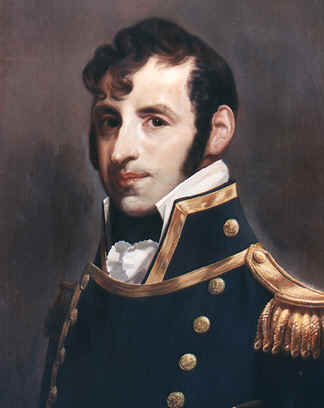
U.S. Naval hero Stephen Decatur
With Veteran’s Day here at last Balladeer’s Blog takes a last look at additional U.S. military actions against Muslim forces.
*** February 16th, 1804 – On October 31st of the previous year the USS Philadelphia had hit an uncharted reef in the Mediterranean Sea while pursuing a Tripolitan Muslim ship. The Philadelphia had foundered and been seized along with her crew by the Muslims of what is now Libya.
On February 16th of 1804 the naval forces under Commodore Edward Preble pulled off a daring action which today would be considered a commando raid or Navy Seals operation. The objective: destroying the captured Philadelphia which the Muslim forces had refitted to guard Tripoli Harbor.
The action was carried out aboard the USS Intrepid, a Tripolitan Muslim ship captured earlier by the USS Enterprise and rechristened as part of the U.S. forces in the region. Flying the flag of England and disguised as a Maltese trading ship the Intrepid entered Tripoli Harbor.
The “undercover” American vessel was granted permission to moor alongside the Muslim ships until morning, pleading a lost anchor as the reason behind the request. Lt Stephen Decatur, a few sailors and a pilot were above deck in appropriate garb to pass as Maltese sea dogs.
Below deck was a force of nearly seventy-five volunteers – nine of Decatur’s fellow Naval Officers, over fifty-four Blue Jackets and eight U.S. Marines. Three of those officers – Lt James Lawrence, Midshipman Charles Morris and Midshipman Thomas McDonough – would go on to greater glory in the War of 1812-1815.
Right underneath the guns of the Pasha’s castle Decatur and his force pulled the Intrepid and Philadelphia together by their lines. Next they boarded the Philadelphia and fought with swords and pikes against the Muslim crew aboard the captured U.S. ship.
The Muslim crew was forced off, with over twenty dead and the rest leaping into the harbor for safety. Decatur’s men scattered various combustibles in the cockpit plus steerage and store rooms then used torches to set the Philadelphia on fire.
After that the men returned to the Intrepid and headed back to the open sea to rejoin the American fleet. Stephen Decatur supposedly leaped from the burning Philadelphia to the departing Intrepid just in time. The massive explosion of the Philadelphia rained fire on the Pasha’s castle and the other Muslim ships in the harbor.
The fires had set off the ship’s loaded cannons before the explosion and random cannonfire pelted the castle and nearly hit the departing Intrepid as well. Amazingly the Americans had suffered no losses and Stephen Decatur was promoted to Captain for this action, making him at twenty-five the youngest Captain in the U.S. Navy at the time.
Even Great Britain’s Lord Nelson called the operation “the most bold and daring act of the age.”
*** After this excitement it was back to blockade duty for months for the American fleet under Commodore Preble. Late July saw Preble taking more direct action.
*** July 25th, 1804 – Commodore Preble’s forces bombarded Tripoli for a full day. Ships involved in the action were the Enterprise (yes, again), the Constitution, the Argus, the Siren, the Vixen, the Scourge, the Nautilus plus six gunboats and two mortar ketches officially borrowed from King Ferdinand IV of the Two Sicilies.
FOR MORE NEGLECTED HISTORY CLICK HERE
FOR SIMILAR ARTICLES AND MORE OF THE TOP LISTS FROM BALLADEER’S BLOG CLICK HERE: https://glitternight.com/top-lists/
© Edward Wozniak and Balladeer’s Blog 2015. Unauthorized use and/or duplication of this material without express and written permission from this blog’s author and/or owner is strictly prohibited. Excerpts and links may be used, provided that full and clear credit is given to Edward Wozniak and Balladeer’s Blog with appropriate and specific direction to the original content.
 Balladeer's Blog
Did Muslims ever get along with non-Muslims?
Only when they had made non-Muslims their slaves.
Go NAVY!
Yep!
Excellent historical reference!
Thanks!